13. German language A1 : Verb Structure in German language
Verbs are the heart of any sentence. Without them, we wouldn’t know what’s happening! In German, verbs work a little differently than in English, but once you understand the patterns, you’ll quickly start building your own sentences.
📌 What Is a Verb? (Was ist ein Verb?)
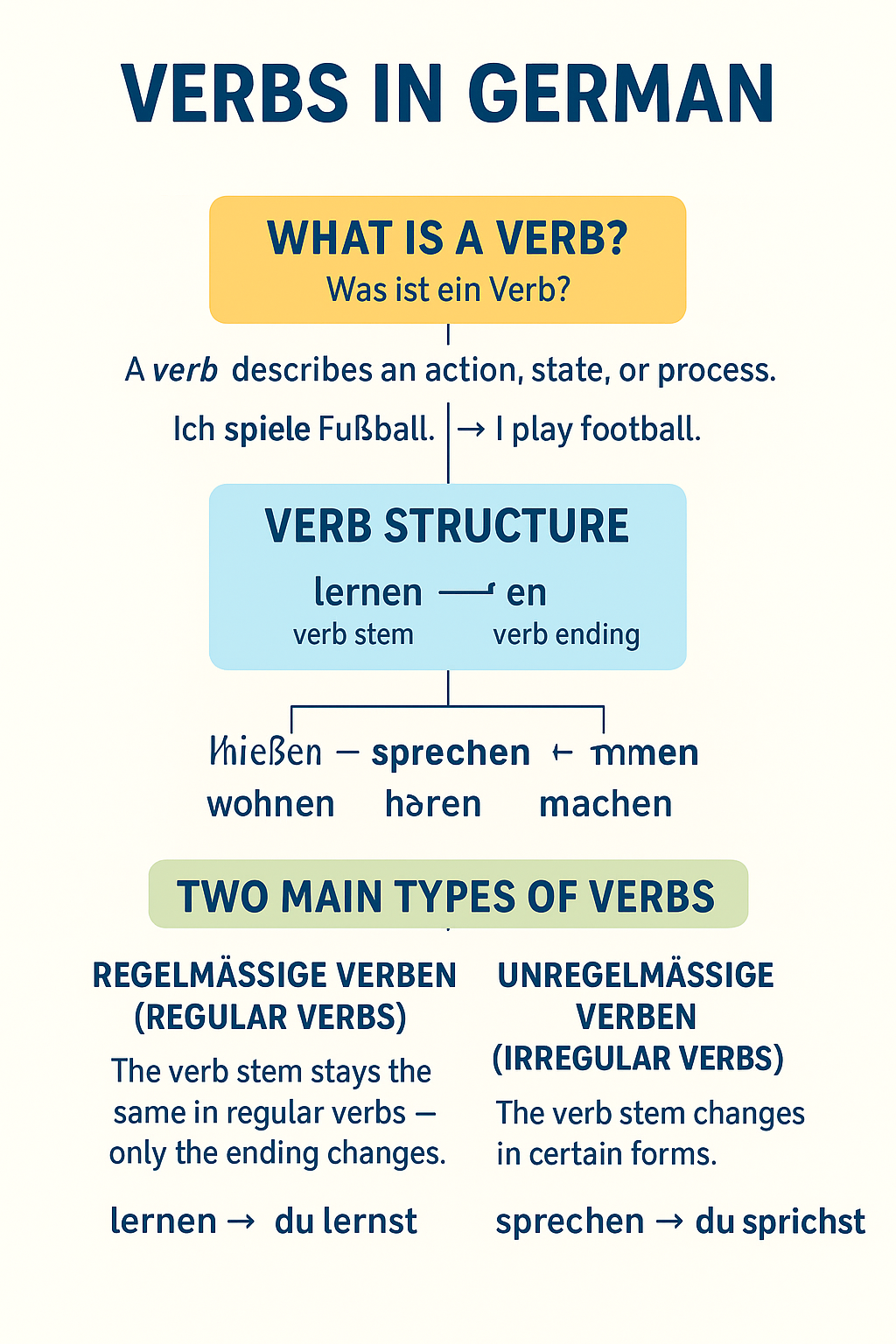
A verb describes an action, state, or process.
🗣 Example:
- Ich spiele Fußball. → I play football.
Here, spiele is the verb. It shows the action.
🔧 Verb Structure (Verbstruktur)
Let’s look at a verb in its base form — the infinitive.
✅ Example:
- lernen = to learn
- lern- → verb stem (Verbstamm)
- -en → verb ending (Endung)
Most German verbs in the infinitive end in -en or -n.
Common infinitive verbs:
- heißen — to be called
- sprechen — to speak
- kommen — to come
- wohnen — to live
- hören — to hear / listen
- machen — to do / make
💡 Tip: Always learn the verb in its infinitive form first!
🔁 Verb Conjugation (Verbkonjugation)
A verb changes its form (is conjugated) depending on the subject in the sentence.
🗣 Examples:
- Ich komme aus China. → I come from China.
- Kommt ihr aus Japan? → Do you all come from Japan?
Both use kommen, but the form changes with the subject (ich vs. ihr).
👥 Personal Pronouns Affect the Verb Form
Verb endings depend on two things:
- Person (1st, 2nd, 3rd)
- Number (singular or plural)
That’s why knowing your personal pronouns is key to conjugating verbs correctly!
🔍 Two Main Types of Verbs in German
1. ✅ Regelmäßige Verben (Regular Verbs)
Regular verbs keep the same stem; only the endings change.
Example:
- lernen → du lernst (you learn)
👉 We covered the regular endings already in Day 12 — check that out if you missed it!
2. ⚠️ Unregelmäßige Verben (Irregular Verbs)
Irregular verbs change their stems in certain forms, especially in du and er/sie/es.
Examples:
- sprechen → du sprichst
- essen → du isst
- sehen → du siehst
- fahren → du fährst
- nehmen → du nimmst
- treffen → du triffst
These don’t follow a fixed rule, so memorization and practice are essential.
🎯 Recap
- A verb shows action and is central to sentence structure.
- Most infinitives end in -en or -n.
- Regular verbs = stable stems, predictable endings.
- Irregular verbs = stem changes in some forms.
- Conjugation depends on person and number (who is doing the action).
📘 What’s Next?
Tomorrow, we’ll take this further by breaking down the conjugation patterns for regular vs. irregular verbs step by step.
✨ Follow along for daily German learning — just 30 minutes a day can make a huge difference!

Mastering German Dating Phrases

German at the Doctor: Essential Phrases, Vocabulary, and Tips

Top German vocabulary for traveling.
100 German Sentences for Beginners (With English Meaning)

25. German language A1: The Family (Die Familie) in German.

Leave a Reply