23 : German language A1 : colloquial and unofficial way time in German
When learning German, most learners are first introduced to the official way of telling time (using the 24-hour clock: dreizehn Uhr, achtzehn Uhr, etc.). However, in everyday conversation, Germans often use a more colloquial and unofficial way to talk about the time. This can be confusing at first, especially if you’re used to the more straightforward “official” style.
Let’s break it down step by step.

Asking for the Time
The most common question is:
Wie spät ist es? – What time is it?
You can also hear:
Wieviel Uhr ist es? – What time is it (literally: how many o’clock is it)?
Full Hours
For the full hours, it’s simple. In colloquial German, you just say:
- 01:00 – Es ist eins.
- 02:00 – Es ist zwei.
- 06:00 – Es ist sechs.
- 12:00 – Es ist zwölf.
- 00:00 – Es ist Mitternacht.
If you want to be more formal or precise, you use the 24-hour format:
- 13:00 – Es ist dreizehn Uhr.
- 18:00 – Es ist achtzehn Uhr.
- 14:00 – Es ist vierzehn Uhr.
In everyday life, though, the 12-hour system with context is much more common. People usually clarify with morgens (morning), nachmittags (afternoon), abends (evening), or nachts (at night).
Minutes Past the Hour
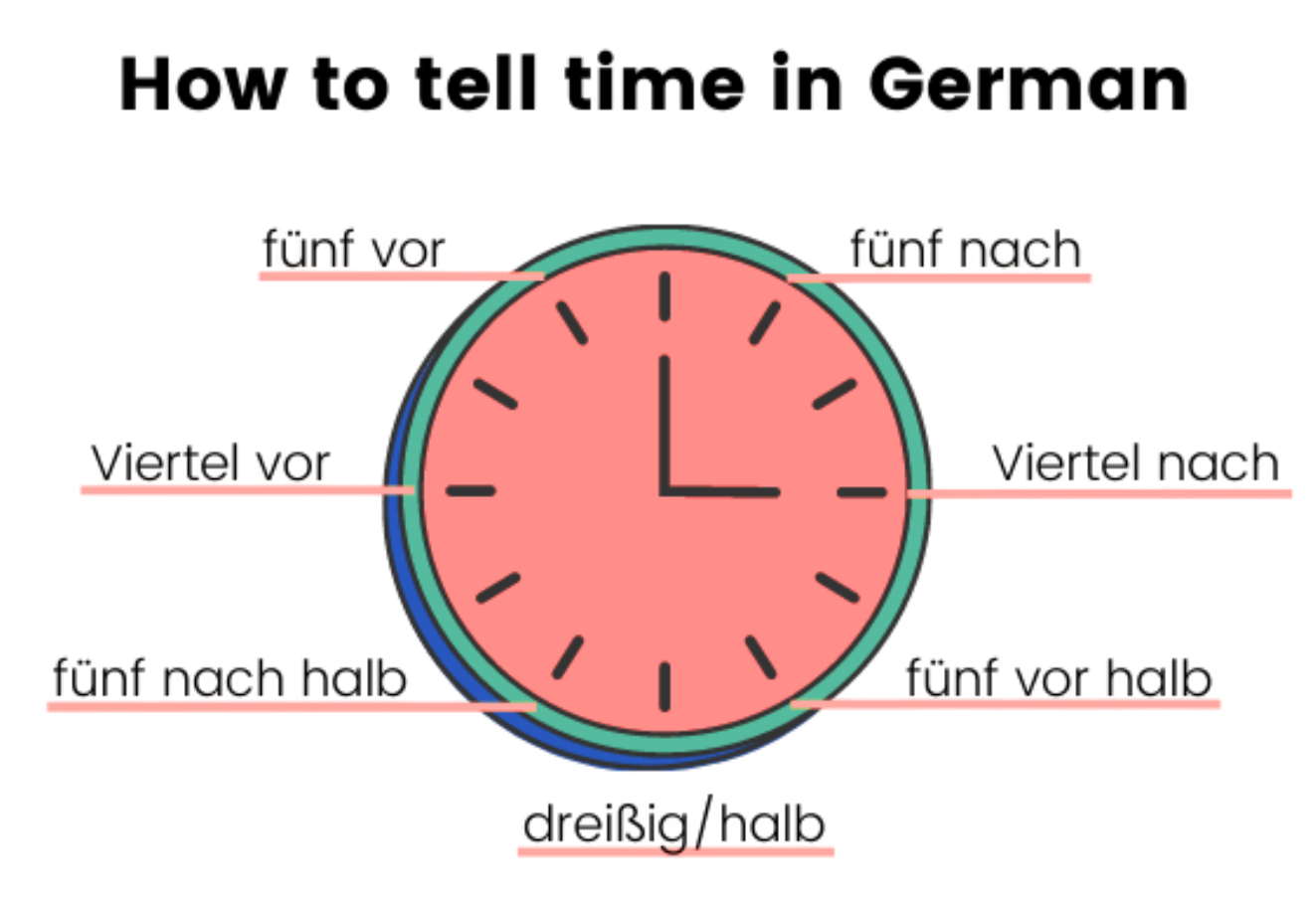
To say times a few minutes past, Germans use nach (after/past):
- 01:05 – Es ist fünf nach eins. (five past one)
- 01:10 – Es ist zehn nach eins. (ten past one)
- 01:20 – Es ist zwanzig nach eins. (twenty past one)
Quarter Hours
This is where German colloquial time gets a little tricky – but fun!
- 01:15 – Es ist Viertel nach eins. (quarter past one)
- 01:45 – Es ist Viertel vor zwei. (quarter to two)
Notice how Germans often use viertel to indicate the quarters of the hour.
The Half-Hour
Unlike English, Germans don’t say half past one. Instead, they look forward to the next hour:
- 01:30 – Es ist halb zwei. (half two = half past one)
This takes some getting used to!
The 25s and 35s
Here’s where colloquial German is wonderfully flexible. For times near the half-hour, you’ll often hear two possible versions:
- 01:25 – Es ist fünfundzwanzig nach eins (twenty-five past one)
or
Es ist fünf vor halb zwei (five before half two = 1:25). - 01:35 – Es ist fünfundzwanzig vor zwei (twenty-five to two)
or
Es ist fünf nach halb zwei (five after half two = 1:35).
This style takes some practice but sounds very natural once you get used to it.
Minutes to the Hour
For times approaching the next hour, Germans use vor (before/to):
- 01:40 – Es ist zwanzig vor zwei. (twenty to two)
- 01:50 – Es ist zehn vor zwei. (ten to two)
- 01:55 – Es ist fünf vor zwei. (five to two)
Approximations
Just like in English, Germans also use casual phrases like almost or just after:
- 01:58 – Es ist kurz vor zwei. (just before two)
- 01:58 – Es ist fast zwei. (almost two)
- 01:58 – Es ist gleich zwei. (nearly two)
- 02:03 – Es ist kurz nach zwei. (just after two)
- 02:27 – Es ist kurz vor halb drei. (just before half three = 2:30)
- 02:34 – Es ist kurz nach halb drei. (just after half three = 2:30)
Summary
- Use nach for minutes past the hour.
- Use vor for minutes to the hour.
- Viertel marks the quarters: Viertel nach / Viertel vor.
- Halb refers to the next hour, not the current one.
- Everyday speech is flexible: both fünfundzwanzig nach eins and fünf vor halb zwei are correct.
- Approximations (kurz vor, kurz nach, fast, gleich) make your German sound more natural.
Final Tip
If you want to sound authentically German, practice the “half” and “quarter” system. That’s what confuses learners the most but also makes you sound the most natural once you master it! ist kurz nach zwei

Mastering German Dating Phrases

German at the Doctor: Essential Phrases, Vocabulary, and Tips

Top German vocabulary for traveling.

100 German Sentences for Beginners (With English Meaning)

25. German language A1: The Family (Die Familie) in German.

Leave a Reply