24.German language A1: Possessive Articles in German
When speaking German, we often need to say “my car,” “your cat,” “his book,” etc. For this, we use Possessivartikel (possessive articles).
Just like in English, possessive articles depend on the subject (who owns the thing). But in German, they also depend on the gender and number of the noun.
Rule of Thumb
- For masculine (der) and neuter (das) nouns → use forms like mein, dein, sein, ihr, unser, euer, Ihr.
- For feminine (die) and plural (die) nouns → add -e → meine, deine, seine, ihre, unsere, eure, Ihre.
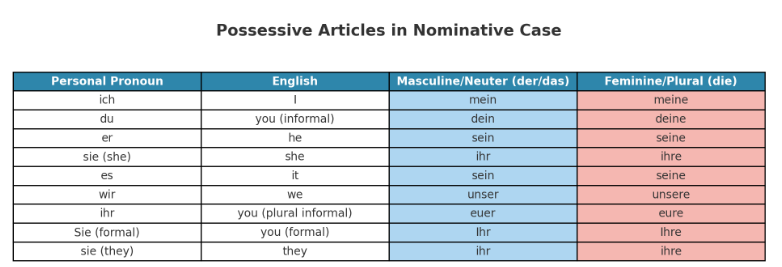
Personal Pronouns and Possessive Articles (Nominative)
| Personal Pronoun | English | Possessive Article (m/n) | Possessive Article (f/pl) |
|---|---|---|---|
| ich (I) | I | mein | meine |
| du (you, informal singular) | you | dein | deine |
| er (he) | he | sein | seine |
| sie (she) | she | ihr | ihre |
| es (it) | it | sein | seine |
| wir (we) | we | unser | unsere |
| ihr (you all, informal) | you all | euer | eure |
| Sie (you, formal) | you (formal, singular/plural) | Ihr | Ihre |
| sie (they) | they | ihr | ihre |
Examples with Translation
Let’s go step by step with examples for each pronoun.
ich → mein / meine (my)
- Das ist mein Fernseher. (This is my television.)
- Das ist mein Auto. (This is my car.)
- Das ist meine Katze. (This is my cat.)
- Das sind meine Bücher. (These are my books.)
du → dein / deine (your – informal)
- Das ist dein Fernseher. (This is your television.)
- Das ist dein Auto. (This is your car.)
- Das ist deine Katze. (This is your cat.)
- Das sind deine Bücher. (These are your books.)
er → sein / seine (his)
- Das ist sein Fernseher. (This is his television.)
- Das ist sein Auto. (This is his car.)
- Das ist seine Katze. (This is his cat.)
- Das sind seine Bücher. (These are his books.)
sie → ihr / ihre (her)
- Das ist ihr Fernseher. (This is her television.)
- Das ist ihr Auto. (This is her car.)
- Das ist ihre Katze. (This is her cat.)
- Das sind ihre Bücher. (These are her books.)
es → sein / seine (its)
- Das ist sein Fernseher. (This is its television.)
- Das ist sein Auto. (This is its car.)
- Das ist seine Katze. (This is its cat.)
- Das sind seine Bücher. (These are its books.)
wir → unser / unsere (our)
- Das ist unser Fernseher. (This is our television.)
- Das ist unser Auto. (This is our car.)
- Das ist unsere Katze. (This is our cat.)
- Das sind unsere Bücher. (These are our books.)
ihr → euer / eure (your, plural informal)
- Das ist euer Fernseher. (This is your television.)
- Das ist euer Auto. (This is your car.)
- Das ist eure Katze. (This is your cat.)
- Das sind eure Bücher. (These are your books.)
Sie → Ihr / Ihre (your, formal)
- Das ist Ihr Fernseher. (This is your television, formal.)
- Das ist Ihr Auto. (This is your car, formal.)
- Das ist Ihre Katze. (This is your cat, formal.)
- Das sind Ihre Bücher. (These are your books, formal.)
sie → ihr / ihre (their)
- Das ist ihr Fernseher. (This is their television.)
- Das ist ihr Auto. (This is their car.)
- Das ist ihre Katze. (This is their cat.)
- Das sind ihre Bücher. (These are their books.)
Key Takeaways
- Masculine and neuter nouns → no -e ending (mein Auto, dein Fernseher).
- Feminine and plural nouns → add -e (meine Katze, deine Bücher).
- Formal “you” (Sie) always capitalized → Ihr/Ihre.
- Some forms (like sein for er/es, or ihr for sie/she vs. sie/they) look the same — context tells you who is meant.

Mastering German Dating Phrases
Whether you’re traveling in Germany, dating a German speaker, or just want to impress someone…

German at the Doctor: Essential Phrases, Vocabulary, and Tips
Visiting a doctor in Germany can feel intimidating if you’re not fluent in German. From…

Top German vocabulary for traveling.
Learning some basic German vocabulary can make traveling in Germany much easier and more enjoyable….
100 German Sentences for Beginners (With English Meaning)
Learning German doesn’t have to be difficult. One of the best ways to start speaking…

25. German language A1: The Family (Die Familie) in German.
The Family is one of the first topics you’ll learn in German (A1 level). Talking…
24.German language A1: Possessive Articles in German
When speaking German, we often need to say “my car,” “your cat,” “his book,” etc….

Leave a Reply