
German Language Tips for Beginners
Learning German can seem challenging, but with the right approach, you’ll make steady progress. Here are some key tips to help you on your journey.
1. Learn the German Alphabet and Pronunciation
- German has a few unique letters: ä, ö, ü (Umlauts) and ß (Eszett, pronounced like “ss”).
- Some tricky pronunciations:
- “ch” in ich sounds soft, while in Buch it has a harsher, throatier sound.
- “w” is pronounced as an English “v” (e.g., Wasser = “Vasser”).
- “z” is pronounced like “ts” (e.g., Zeit = “Tsait”).
2. Understand Basic Sentence Structure
- German follows Subject-Verb-Object (SVO) order in simple sentences:
- Ich liebe Deutsch. (I love German.)
- In subordinate clauses, the verb moves to the end:
- Ich weiß, dass du müde bist. (I know that you are tired.)
3. Master German Noun Genders
- Every noun has a gender:
- Masculine: der Tisch (the table)
- Feminine: die Lampe (the lamp)
- Neuter: das Buch (the book)
- Always learn nouns with their definite article to make grammar easier.
4. Get Comfortable with Cases
- German has four cases that affect articles and adjectives:
- Nominative (subject): Der Hund schläft. (The dog sleeps.)
- Accusative (direct object): Ich sehe den Hund. (I see the dog.)
- Dative (indirect object): Ich gebe dem Hund Futter. (I give the dog food.)
- Genitive (possession): Das ist das Spielzeug des Hundes. (That is the dog’s toy.)
5. Use Cognates to Your Advantage
- Many German words are similar to English:
- Musik (music), Hotel (hotel), Kaffee (coffee).
- But watch out for false friends:
- Gift = poison (not a present!)
- Bald = soon (not without hair!)
6. Learn Common Verbs and Their Conjugations
- Start with essential verbs like sein (to be) and haben (to have):
- Ich bin müde. (I am tired.)
- Du hast ein Buch. (You have a book.)
- Regular verbs follow patterns, but irregular verbs require memorization.
7. Practice Daily with Immersion
- Listen to German podcasts and music (Slow German, DW Learn German).
- Watch German TV shows and movies (Dark, Tatort).
- Use language learning apps (Duolingo, Babbel, Anki).
- Try speaking daily, even if just simple sentences.
8. Don’t Be Afraid to Make Mistakes
Making mistakes is normal. Keep practicing, and your confidence will grow.
Final Tip: Consistency is key! A little bit of daily practice will go a long way. Viel Erfolg! (Good luck!) 🚀
Let me know if you need more explanations or specific resources! 😊

Mastering German Dating Phrases
Whether you’re traveling in Germany, dating a German speaker, or just want to impress someone…

German at the Doctor: Essential Phrases, Vocabulary, and Tips
Visiting a doctor in Germany can feel intimidating if you’re not fluent in German. From…

Top German vocabulary for traveling.
Learning some basic German vocabulary can make traveling in Germany much easier and more enjoyable….
100 German Sentences for Beginners (With English Meaning)
Learning German doesn’t have to be difficult. One of the best ways to start speaking…

25. German language A1: The Family (Die Familie) in German.
The Family is one of the first topics you’ll learn in German (A1 level). Talking…
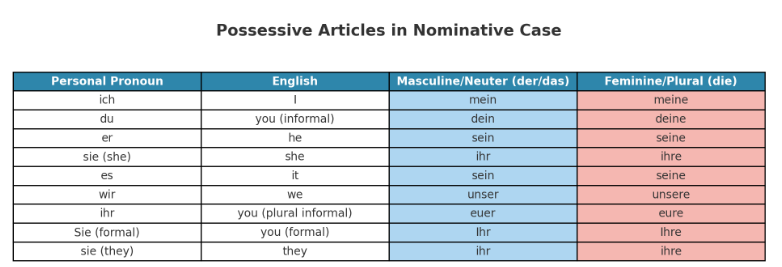
24.German language A1: Possessive Articles in German
When speaking German, we often need to say “my car,” “your cat,” “his book,” etc….

Leave a Reply