
Understanding the Difference Between Accusative and Dative in German
When learning German, one of the trickiest aspects for beginners is mastering the cases — particularly the accusative and dative cases. Unlike English, where word order often dictates meaning, German relies on grammatical cases to show the role a noun or pronoun plays in a sentence. The accusative and dative cases, each with specific functions, determine how articles, adjectives, and pronouns are used.
In this blog, we’ll explore the key differences between the accusative and dative cases, when to use each, and how to recognize them in sentences.
What Are German Cases?
German has four grammatical cases:
- Nominative: Marks the subject of the sentence (who or what is doing the action).
- Accusative: Marks the direct object (who or what is directly affected by the action).
- Dative: Marks the indirect object (who or what benefits from the action).
- Genitive: Marks possession or relationships between things (less commonly used today).
In this blog, we’ll focus on the accusative and dative cases, as they are crucial for everyday German conversations.
The Accusative Case (Akkusativ)
What Is the Accusative Case?
The accusative case is used to indicate the direct object of a sentence — the person or thing that is directly affected by the verb’s action.
Example:
- Ich sehe den Hund.
(I see the dog.)
Here, “den Hund” (the dog) is the direct object because it is the thing being seen.
Key Accusative Prepositions:
Certain prepositions always trigger the accusative case, regardless of the verb. Some common ones include:
- durch (through)
- für (for)
- gegen (against)
- ohne (without)
- um (around)
Example:
- Ich gehe ohne dich.
(I’m going without you.)
“Dich” (you) is in the accusative case, as “ohne” triggers this case.
Accusative Articles:
In the accusative case, the masculine definite and indefinite articles change form. Feminine, neuter, and plural forms remain the same as in the nominative case.
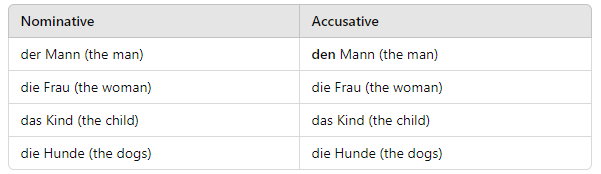
For indefinite articles, the pattern is similar:
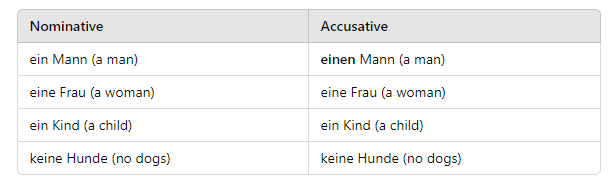
Accusative Pronouns:
When using personal pronouns in the accusative case, some forms change.

Example:
- Ich sehe dich.
(I see you.)
“Dich” is the accusative form of “du.”
The Dative Case (Dativ)
What Is the Dative Case?
The dative case is used to indicate the indirect object — the recipient of the direct object or the person benefiting from the action.
Example:
- Ich gebe dem Mann das Buch.
(I give the man the book.)
Here, “dem Mann” (the man) is the indirect object because he is receiving the book. “Das Buch” (the book) is the direct object.
Key Dative Prepositions:
Some prepositions always require the dative case, regardless of the verb. Common dative prepositions include:
- aus (out of)
- bei (at, near)
- mit (with)
- nach (after, to)
- seit (since)
- von (from, of)
- zu (to)
Example:
- Ich fahre mit dem Bus.
(I’m going by bus.)
“Dem Bus” is in the dative case because “mit” requires the dative.
Dative Articles:
In the dative case, the definite and indefinite articles change for all genders, not just the masculine form.
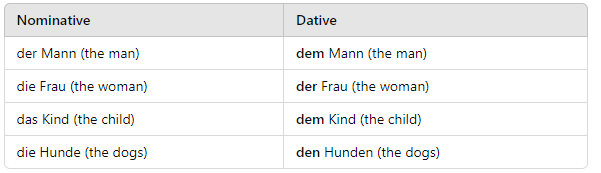
For indefinite articles, the pattern is as follows:

Dative Pronouns:
Personal pronouns also change in the dative case.

Example:
- Ich schenke ihr Blumen.
(I give her flowers.)
“Ihr” is the dative form of “sie.”
Accusative vs. Dative: How to Choose the Right Case
Step 1: Identify the Verb
Certain verbs in German dictate whether the accusative or dative case is required. Most transitive verbs (verbs that require a direct object) use the accusative, while certain verbs naturally require the dative.
- Accusative verbs: Common verbs that typically take a direct object include “sehen” (to see), “hören” (to hear), and “haben” (to have).
- Example: Ich höre den Lehrer. (I hear the teacher.)
- Dative verbs: Some verbs, like “helfen” (to help), “danken” (to thank), and “gefallen” (to please), require the dative case.
- Example: Ich danke dem Lehrer. (I thank the teacher.)
Step 2: Identify Direct and Indirect Objects
If the verb takes both a direct and indirect object, use the accusative for the direct object and the dative for the indirect object.
Example:
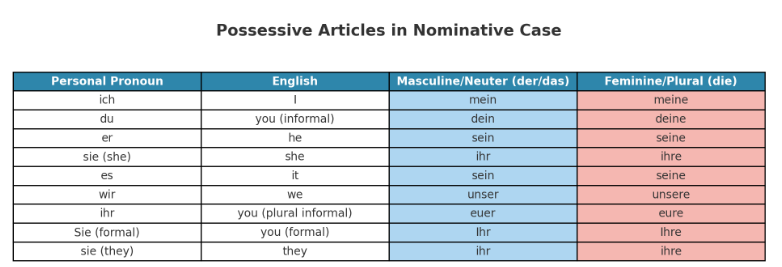
- Ich schicke meiner Freundin eine Nachricht.
(I send my friend a message.)
Here, “meiner Freundin” (my friend) is the indirect object (dative), and “eine Nachricht” (a message) is the direct object (accusative).
Step 3: Pay Attention to Prepositions
Some prepositions always require either the accusative or dative case, while others (like an, auf, in) can switch between the two, depending on the context (whether there is movement or location). If there is movement toward something, use the accusative; if it refers to a stationary location, use the dative.
- Ich gehe in die Schule. (I’m going to school.) — Accusative (motion)
- Ich bin in der Schule. (I’m in school.) — Dative (location)
Conclusion: Mastering Accusative and Dative
Learning the difference between the accusative and dative cases in German can feel overwhelming at first, but with practice and a clear understanding of the rules, it becomes second nature. Start by identifying the roles of nouns in sentences — are they direct objects or indirect objects? Pay close attention to prepositions and memorize verbs that require specific cases.
By taking a systematic approach and practicing with real-life examples, you’ll be well on your way to mastering these crucial aspects of German grammar!

Mastering German Dating Phrases

German at the Doctor: Essential Phrases, Vocabulary, and Tips

Top German vocabulary for traveling.

100 German Sentences for Beginners (With English Meaning)

25. German language A1: The Family (Die Familie) in German.

1 comment so far