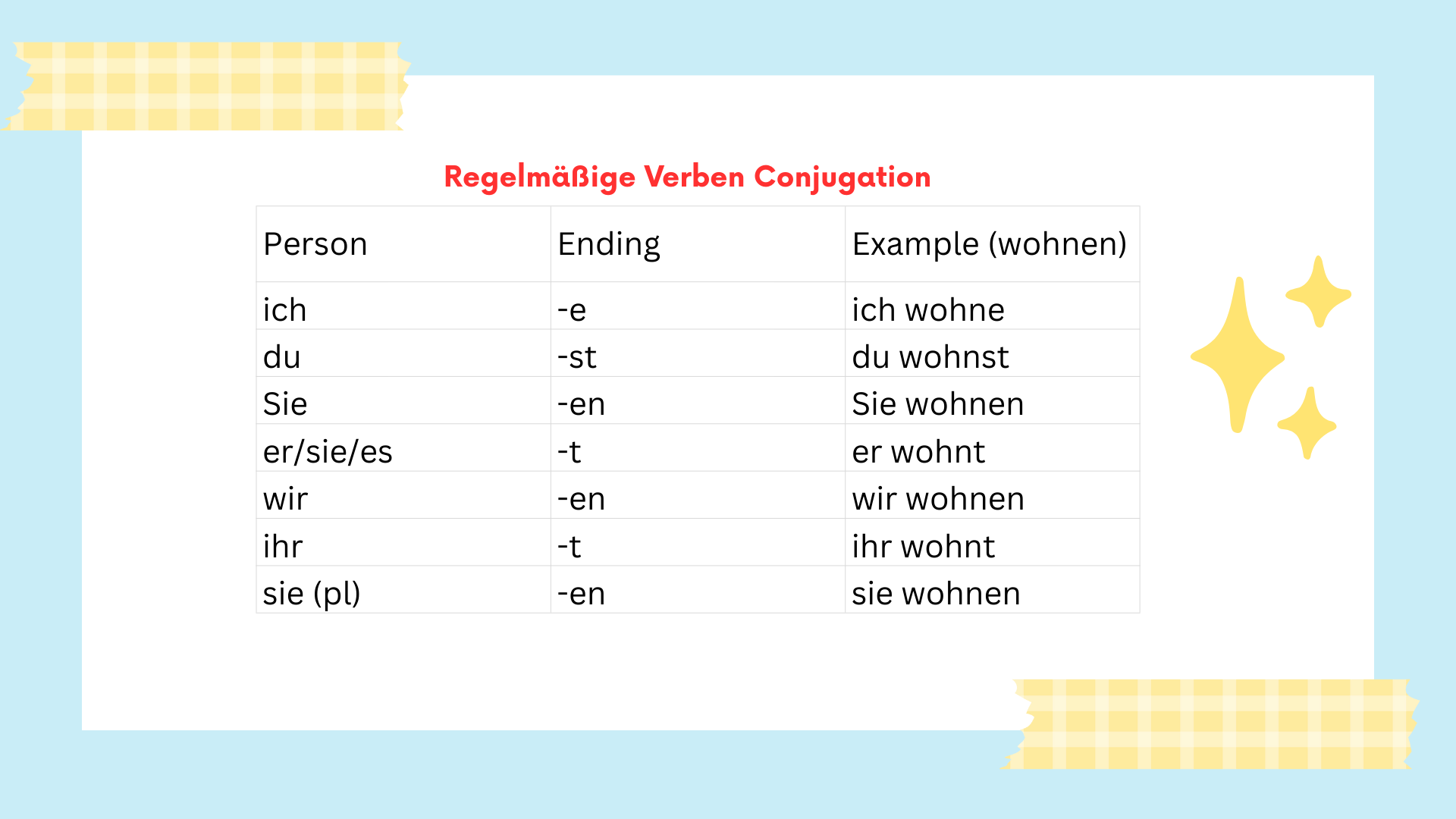
14. German language A1 : Regelmäßige Verben Conjugation
Yesterday we learned the basics of verb structure. Today, we’ll dive deeper into regular verbs (Regelmäßige Verben) and how to conjugate them in the present tense.
📌 What You’ll Learn Today:
- How to conjugate regular verbs (Regelmäßige Verben) in German
- Present tense structure (Präsens)
- Special spelling rules based on verb endings
🔧 Verb Conjugation in Present Tense (Verbkonjugation im Präsens)
Regular verbs follow a predictable pattern:
Verb stem (Stamm) + personal ending (Endung)
📋 Conjugation Pattern:
| Person | Ending | Example (wohnen) |
|---|---|---|
| ich | -e | ich wohne |
| du | -st | du wohnst |
| Sie | -en | Sie wohnen |
| er/sie/es | -t | er wohnt |
| wir | -en | wir wohnen |
| ihr | -t | ihr wohnt |
| sie (pl) | -en | sie wohnen |
🔄 Examples of Regular Verbs
Let’s conjugate some common regular verbs:
1. Machen (to do, to make)
- ich mache
- du machst
- er/sie/es macht
- wir machen
- ihr macht
- Sie/sie machen
2. Spielen (to play)
- ich spiele
- du spielst
- er/sie/es spielt
- wir spielen
- ihr spielt
- Sie/sie spielen
3. Studieren (to study)
(Note: ends in -ieren, conjugated without -e in stem)
- ich studiere
- du studierst
- er/sie/es studiert
- wir studieren
- ihr studiert
- Sie/sie studieren
4. Lernen (to learn)
- ich lerne
- du lernst
- er/sie/es lernt
- wir lernen
- ihr lernt
- Sie/sie lernen
🎧 Special Pronunciation Rules
✅ Verbs ending in -s, -ß, or -z
In the du form, use -t instead of -st
Reisen (to travel)
- du reist (not reisst)
Tanzen (to dance)
- du tanzt (not tanzst)
✅ Verbs ending in -d or -t
Add an extra -e- before endings that begin with t or st
Arbeiten (to work)
- du arbeitest
- er arbeitet
Warten (to wait)
- du wartest
- er wartet
Antworten (to answer)
- du antwortest
- er antwortet
🧠 Recap
Today we learned how to:
- Conjugate regular verbs in the present tense
- Handle spelling adjustments with verb stems ending in -s, -ß, -z, -d, or -t
✨ With regular practice, these patterns become second nature!
Mastering German Dating Phrases
Whether you’re traveling in Germany, dating a German speaker, or just want to impress someone…
German at the Doctor: Essential Phrases, Vocabulary, and Tips
Visiting a doctor in Germany can feel intimidating if you’re not fluent in German. From…

Top German vocabulary for traveling.
Learning some basic German vocabulary can make traveling in Germany much easier and more enjoyable….
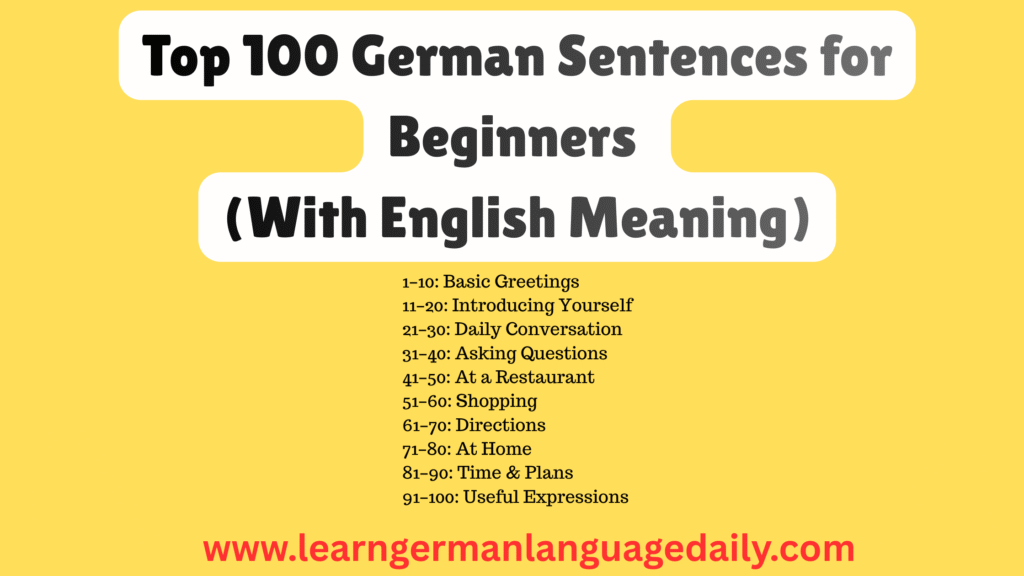
100 German Sentences for Beginners (With English Meaning)
Learning German doesn’t have to be difficult. One of the best ways to start speaking…

25. German language A1: The Family (Die Familie) in German.
The Family is one of the first topics you’ll learn in German (A1 level). Talking…
24.German language A1: Possessive Articles in German
When speaking German, we often need to say “my car,” “your cat,” “his book,” etc….

Leave a Reply