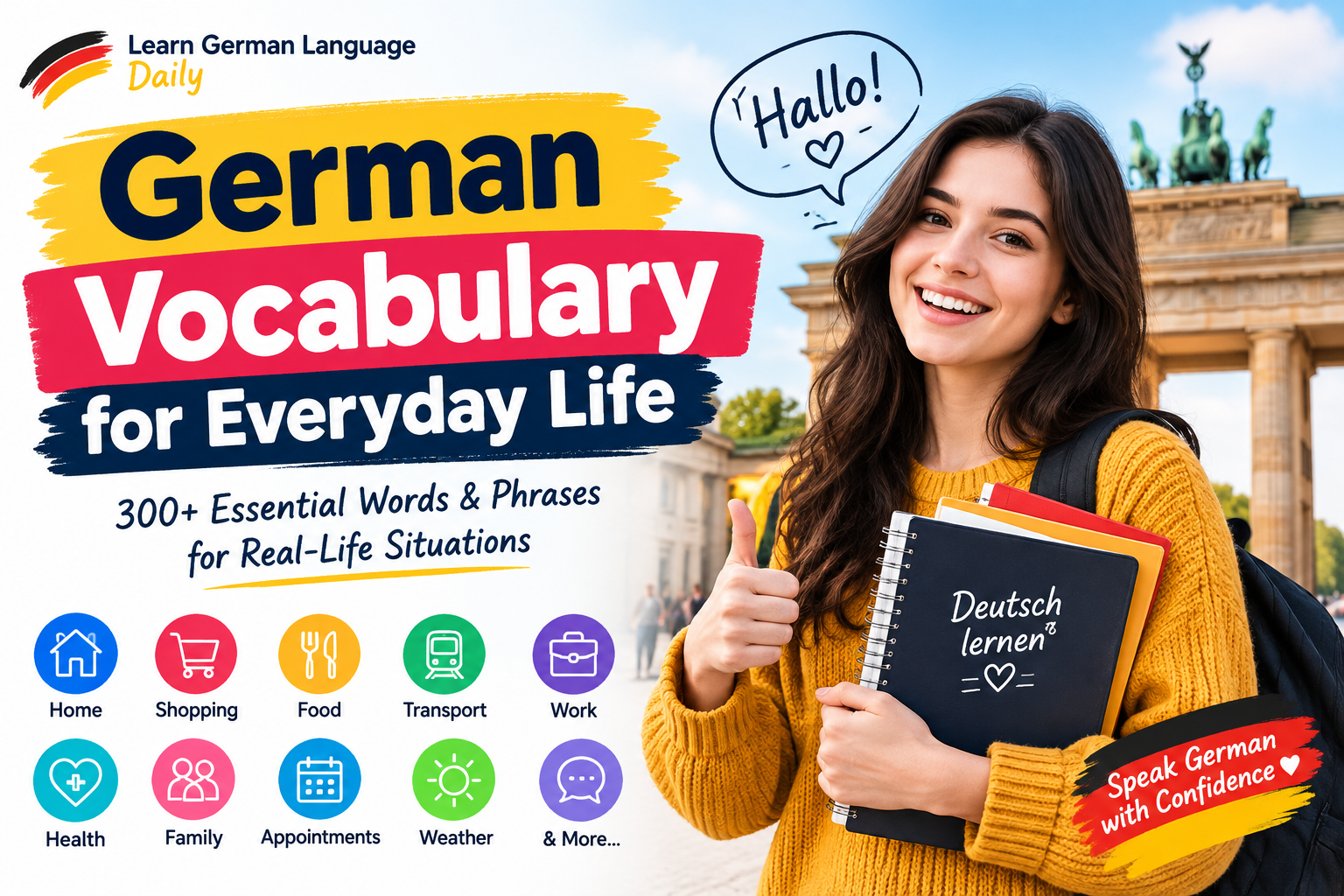
German Vocabulary for Everyday Life: 300+ Essential German Words and Phrases
Learning German vocabulary is much easier when you learn words that you actually use in everyday life.
You don’t need to memorize thousands of random German words before you can start speaking. Instead, focus on the vocabulary you need for shopping, work, travel, food, home, health, transportation, appointments, conversations and daily activities.
This guide contains essential German vocabulary for everyday life, with English meanings and useful example sentences.
Whether you are a beginner learning German at A1 or A2 level, preparing for B1, moving to Germany, or simply trying to speak German more confidently, these words and phrases will help you communicate in real-life situations.
Why Is Everyday German Vocabulary Important?
Grammar is important, but vocabulary allows you to communicate.
Imagine that you know German grammar very well but don’t know these words:
- bezahlen
- einkaufen
- Termin
- Rechnung
- Apotheke
- Bahnhof
- Wohnung
- Arbeit
It becomes difficult to manage everyday situations.
On the other hand, if you know useful vocabulary, you can already communicate simple ideas:
Ich habe morgen einen Termin.
I have an appointment tomorrow.
Wo ist der Bahnhof?
Where is the train station?
Ich möchte mit Karte bezahlen.
I would like to pay by card.
Ich suche eine Wohnung.
I am looking for an apartment.
This is why learning high-frequency everyday vocabulary is one of the best ways to improve your German.
1. Basic German Words for Everyday Conversation
Let’s start with words and expressions you will hear every day.
| German | English |
|---|---|
| ja | yes |
| nein | no |
| vielleicht | maybe |
| natürlich | of course |
| genau | exactly |
| wirklich | really |
| schon | already |
| noch | still / yet |
| immer | always |
| nie | never |
| oft | often |
| manchmal | sometimes |
| heute | today |
| morgen | tomorrow |
| gestern | yesterday |
| jetzt | now |
| später | later |
| hier | here |
| dort | there |
| zusammen | together |
| allein | alone |
| richtig | correct |
| falsch | wrong |
| wichtig | important |
| möglich | possible |
Useful examples
Ja, genau.
Yes, exactly.
Vielleicht später.
Maybe later.
Das ist wirklich wichtig.
That is really important.
Ich weiß es noch nicht.
I don’t know yet.
2. Greetings and Polite German
Knowing how to greet people is essential in Germany.
Common greetings
| German | English |
|---|---|
| Hallo! | Hello! |
| Guten Morgen! | Good morning! |
| Guten Tag! | Good afternoon / Hello! |
| Guten Abend! | Good evening! |
| Gute Nacht! | Good night! |
| Tschüss! | Bye! |
| Auf Wiedersehen! | Goodbye! |
| Bis später! | See you later! |
| Bis morgen! | See you tomorrow! |
Polite expressions
| German | English |
|---|---|
| bitte | please / you’re welcome |
| danke | thank you |
| vielen Dank | thank you very much |
| Entschuldigung | excuse me / sorry |
| kein Problem | no problem |
| gern | gladly |
| gerne | gladly |
| kein Problem | no problem |
Examples
Guten Morgen! Wie geht es Ihnen?
Good morning! How are you?
Vielen Dank für Ihre Hilfe.
Thank you very much for your help.
Entschuldigung, können Sie mir helfen?
Excuse me, can you help me?
3. German Vocabulary for the Home
If you live in Germany, you will use these words constantly.
Rooms
| German | English |
|---|---|
| die Wohnung | apartment |
| das Haus | house |
| das Wohnzimmer | living room |
| das Schlafzimmer | bedroom |
| die Küche | kitchen |
| das Badezimmer | bathroom |
| der Flur | hallway |
| der Balkon | balcony |
| der Keller | basement |
| der Garten | garden |
| die Garage | garage |
Furniture and objects
| German | English |
|---|---|
| der Tisch | table |
| der Stuhl | chair |
| das Sofa | sofa |
| das Bett | bed |
| der Schrank | cupboard / wardrobe |
| das Regal | shelf |
| die Lampe | lamp |
| der Teppich | carpet |
| der Kühlschrank | refrigerator |
| der Herd | stove |
| die Waschmaschine | washing machine |
| der Fernseher | television |
| der Schlüssel | key |
| die Tür | door |
| das Fenster | window |
Useful sentences
Wo ist der Schlüssel?
Where is the key?
Die Waschmaschine ist im Keller.
The washing machine is in the basement.
Ich mache das Fenster auf.
I open the window.
4. German Vocabulary for Daily Activities
These verbs are extremely important because they describe what you do every day.
| German | English |
|---|---|
| aufstehen | to get up |
| aufwachen | to wake up |
| duschen | to shower |
| frühstücken | to have breakfast |
| arbeiten | to work |
| lernen | to learn |
| einkaufen | to shop |
| kochen | to cook |
| essen | to eat |
| trinken | to drink |
| schlafen | to sleep |
| lesen | to read |
| schreiben | to write |
| sprechen | to speak |
| hören | to listen/hear |
| sehen | to see/watch |
| fahren | to drive/go |
| laufen | to walk/run |
| warten | to wait |
| treffen | to meet |
| besuchen | to visit |
| putzen | to clean |
| waschen | to wash |
| bezahlen | to pay |
Example
Ich stehe jeden Morgen um sieben Uhr auf.
I get up at seven every morning.
Nach der Arbeit gehe ich einkaufen.
After work, I go shopping.
Am Abend koche ich zu Hause.
In the evening, I cook at home.
5. German Vocabulary for Food and Drinks
Food vocabulary is essential when living in Germany.
Basic food
| German | English |
|---|---|
| das Brot | bread |
| das Brötchen | bread roll |
| die Butter | butter |
| der Käse | cheese |
| die Milch | milk |
| der Joghurt | yogurt |
| das Ei | egg |
| der Reis | rice |
| die Nudeln | pasta |
| die Kartoffel | potato |
| das Gemüse | vegetables |
| das Obst | fruit |
| der Apfel | apple |
| die Banane | banana |
| die Orange | orange |
| die Tomate | tomato |
| die Zwiebel | onion |
| der Salat | salad |
| die Suppe | soup |
Drinks
| German | English |
|---|---|
| das Wasser | water |
| der Kaffee | coffee |
| der Tee | tea |
| der Saft | juice |
| die Limonade | lemonade / soft drink |
At a restaurant
Ich möchte bitte einen Kaffee.
I would like a coffee, please.
Die Speisekarte, bitte.
The menu, please.
Was empfehlen Sie?
What do you recommend?
Die Rechnung, bitte.
The bill, please.
Kann ich mit Karte bezahlen?
Can I pay by card?
6. German Vocabulary for Shopping
Shopping is one of the most common situations where you need German.
Important words
| German | English |
|---|---|
| der Supermarkt | supermarket |
| das Geschäft | shop |
| der Laden | shop/store |
| der Preis | price |
| das Angebot | offer |
| der Rabatt | discount |
| die Kasse | checkout |
| der Einkaufswagen | shopping cart |
| der Einkaufskorb | shopping basket |
| die Tüte | bag |
| das Geld | money |
| die Karte | card |
| die Rechnung | bill/invoice |
| der Kassenbon | receipt |
| bezahlen | to pay |
| kaufen | to buy |
| verkaufen | to sell |
| kosten | to cost |
Useful shopping phrases
Wie viel kostet das?
How much does that cost?
Haben Sie das auch in einer anderen Größe?
Do you also have this in another size?
Kann ich das anprobieren?
Can I try this on?
Wo ist die Kasse?
Where is the checkout?
Ich möchte das zurückgeben.
I would like to return this.
Haben Sie eine Quittung?
Do you have a receipt?
7. German Vocabulary for Work
If you work in Germany, these words are extremely useful.
| German | English |
|---|---|
| die Arbeit | work |
| der Beruf | profession |
| die Firma | company |
| der Arbeitgeber | employer |
| der Arbeitnehmer | employee |
| der Kollege | male colleague |
| die Kollegin | female colleague |
| der Chef | boss |
| die Chefin | female boss |
| das Team | team |
| das Büro | office |
| das Meeting | meeting |
| die Besprechung | meeting/discussion |
| der Termin | appointment |
| die Aufgabe | task |
| das Projekt | project |
| die Erfahrung | experience |
| das Gehalt | salary |
| der Urlaub | vacation |
| die Pause | break |
| die Arbeitszeit | working hours |
| der Feierabend | end of working day |
Useful workplace sentences
Ich habe heute ein Meeting.
I have a meeting today.
Wann beginnt die Besprechung?
When does the meeting start?
Ich brauche noch etwas Zeit.
I need a little more time.
Können Sie mir bitte helfen?
Could you please help me?
Ich schicke Ihnen die Datei per E-Mail.
I’ll send you the file by email.
8. German Vocabulary for Public Transportation
Germany has an extensive public transportation network, so these words are useful.
| German | English |
|---|---|
| der Bahnhof | train station |
| die Haltestelle | stop |
| der Zug | train |
| die Straßenbahn | tram |
| der Bus | bus |
| die U-Bahn | subway |
| die S-Bahn | suburban train |
| das Taxi | taxi |
| das Ticket | ticket |
| die Fahrkarte | ticket |
| der Fahrplan | timetable |
| die Verspätung | delay |
| die Abfahrt | departure |
| die Ankunft | arrival |
| umsteigen | to change trains/buses |
| einsteigen | to get on |
| aussteigen | to get off |
Useful sentences
Wann fährt der nächste Zug?
When does the next train leave?
Wo muss ich umsteigen?
Where do I have to change?
Hat der Zug Verspätung?
Is the train delayed?
Wo ist die nächste Bushaltestelle?
Where is the nearest bus stop?
9. German Vocabulary for Driving
If you drive in Germany, learn these words.
| German | English |
|---|---|
| das Auto | car |
| das Fahrzeug | vehicle |
| der Führerschein | driving licence |
| die Straße | street/road |
| die Autobahn | motorway |
| die Kreuzung | intersection |
| die Ampel | traffic light |
| der Parkplatz | parking space |
| die Tankstelle | petrol station |
| das Benzin | petrol |
| der Diesel | diesel |
| die Batterie | battery |
| der Reifen | tyre |
| die Werkstatt | garage/workshop |
| die Versicherung | insurance |
| der Unfall | accident |
| die Geschwindigkeit | speed |
| die Ausfahrt | exit |
Useful sentences
Wo kann ich parken?
Where can I park?
Ich muss tanken.
I need to refuel.
Mein Auto ist kaputt.
My car is broken.
Ich muss in die Werkstatt.
I need to go to the garage.
10. German Vocabulary for Health
Knowing basic health vocabulary is very important.
| German | English |
|---|---|
| der Arzt | doctor |
| die Ärztin | female doctor |
| die Arztpraxis | doctor’s office |
| das Krankenhaus | hospital |
| die Apotheke | pharmacy |
| der Termin | appointment |
| die Krankheit | illness |
| die Gesundheit | health |
| die Schmerzen | pain |
| der Kopf | head |
| der Bauch | stomach |
| der Rücken | back |
| der Hals | throat/neck |
| das Bein | leg |
| der Arm | arm |
| das Fieber | fever |
| der Husten | cough |
| die Erkältung | cold |
| das Medikament | medicine |
| das Rezept | prescription |
Useful sentences
Ich habe Kopfschmerzen.
I have a headache.
Ich brauche einen Arzttermin.
I need a doctor’s appointment.
Seit gestern habe ich Fieber.
I’ve had a fever since yesterday.
Wo ist die nächste Apotheke?
Where is the nearest pharmacy?
11. German Vocabulary for Appointments
Appointments are a major part of everyday life in Germany.
You may have appointments for:
- doctors
- banks
- government offices
- schools
- employers
- car workshops
- language courses
Important vocabulary
| German | English |
|---|---|
| der Termin | appointment |
| vereinbaren | to arrange |
| absagen | to cancel |
| verschieben | to postpone |
| bestätigen | to confirm |
| pünktlich | punctual |
| verfügbar | available |
| die Uhrzeit | time |
| das Datum | date |
| der Kalender | calendar |
Useful phrases
Ich möchte einen Termin vereinbaren.
I would like to make an appointment.
Kann ich den Termin verschieben?
Can I postpone the appointment?
Ich muss den Termin leider absagen.
Unfortunately, I have to cancel the appointment.
Passt Ihnen Montag?
Does Monday work for you?
Um wie viel Uhr?
At what time?
12. German Vocabulary for the Weather
Talking about the weather is extremely common in Germany.
| German | English |
|---|---|
| das Wetter | weather |
| die Sonne | sun |
| die Wolke | cloud |
| der Regen | rain |
| der Schnee | snow |
| der Wind | wind |
| der Sturm | storm |
| warm | warm |
| kalt | cold |
| heiß | hot |
| kühl | cool |
| sonnig | sunny |
| bewölkt | cloudy |
| regnerisch | rainy |
| windig | windy |
| trocken | dry |
| nass | wet |
Useful sentences
Wie ist das Wetter heute?
What’s the weather like today?
Heute ist es ziemlich kalt.
It’s quite cold today.
Es regnet den ganzen Tag.
It’s raining all day.
Morgen soll es sonnig werden.
Tomorrow it is supposed to be sunny.
13. German Vocabulary for Family and Relationships
| German | English |
|---|---|
| die Familie | family |
| die Eltern | parents |
| der Vater | father |
| die Mutter | mother |
| der Sohn | son |
| die Tochter | daughter |
| der Bruder | brother |
| die Schwester | sister |
| der Ehemann | husband |
| die Ehefrau | wife |
| der Freund | boyfriend/friend |
| die Freundin | girlfriend/friend |
| das Kind | child |
| die Kinder | children |
| der Nachbar | male neighbour |
| die Nachbarin | female neighbour |
Useful sentences
Ich habe einen Bruder und eine Schwester.
I have a brother and a sister.
Meine Familie lebt in Indien.
My family lives in India.
Meine Frau arbeitet in Deutschland.
My wife works in Germany.
14. German Vocabulary for Time
Time expressions are essential.
| German | English |
|---|---|
| die Sekunde | second |
| die Minute | minute |
| die Stunde | hour |
| der Tag | day |
| die Woche | week |
| der Monat | month |
| das Jahr | year |
| heute | today |
| morgen | tomorrow |
| gestern | yesterday |
| früh | early |
| spät | late |
| morgens | in the morning |
| mittags | at noon |
| nachmittags | in the afternoon |
| abends | in the evening |
| nachts | at night |
Useful expressions
Heute Morgen
this morning
Morgen Abend
tomorrow evening
Nächste Woche
next week
Letzte Woche
last week
In zwei Tagen
in two days
Vor drei Wochen
three weeks ago
15. German Vocabulary for Feelings
Being able to describe how you feel is an important part of communication.
| German | English |
|---|---|
| glücklich | happy |
| traurig | sad |
| müde | tired |
| hungrig | hungry |
| durstig | thirsty |
| nervös | nervous |
| entspannt | relaxed |
| zufrieden | satisfied |
| unzufrieden | dissatisfied |
| überrascht | surprised |
| enttäuscht | disappointed |
| aufgeregt | excited |
| wütend | angry |
| gestresst | stressed |
| krank | sick |
| gesund | healthy |
Examples
Ich bin heute sehr müde.
I’m very tired today.
Ich bin mit dem Ergebnis zufrieden.
I’m satisfied with the result.
Vor der Prüfung bin ich nervös.
I’m nervous before the exam.
16. German Vocabulary for Communication
These expressions are extremely useful when speaking German.
If you don’t understand
Ich verstehe das nicht.
I don’t understand that.
Können Sie das bitte wiederholen?
Could you repeat that, please?
Können Sie bitte langsamer sprechen?
Could you speak more slowly, please?
Was bedeutet das?
What does that mean?
Wie sagt man das auf Deutsch?
How do you say that in German?
If you need clarification
Was meinen Sie damit?
What do you mean by that?
Können Sie mir das erklären?
Can you explain that to me?
Habe ich das richtig verstanden?
Did I understand that correctly?
These phrases are particularly useful for B1 learners.
17. German Vocabulary for Money and Banking
| German | English |
|---|---|
| das Geld | money |
| das Konto | account |
| die Bank | bank |
| die EC-Karte / Girocard | debit card |
| die Kreditkarte | credit card |
| das Bargeld | cash |
| der Geldautomat | ATM |
| die Überweisung | bank transfer |
| die Rechnung | bill/invoice |
| der Betrag | amount |
| der Preis | price |
| das Gehalt | salary |
| die Miete | rent |
| die Kosten | costs |
| bezahlen | pay |
| sparen | save |
| ausgeben | spend |
Useful sentences
Ich möchte Geld abheben.
I would like to withdraw money.
Ich überweise den Betrag heute.
I’ll transfer the amount today.
Wie hoch sind die Kosten?
How much are the costs?
18. German Vocabulary for the City
| German | English |
|---|---|
| die Stadt | city |
| das Stadtzentrum | city centre |
| die Innenstadt | city centre |
| das Rathaus | town hall |
| die Post | post office |
| die Bank | bank |
| die Schule | school |
| die Universität | university |
| die Bibliothek | library |
| das Einkaufszentrum | shopping centre |
| der Supermarkt | supermarket |
| das Restaurant | restaurant |
| das Café | café |
| der Park | park |
| das Museum | museum |
| die Polizei | police |
| die Feuerwehr | fire brigade |
19. German Vocabulary for Emergencies
Some vocabulary is especially important because you may need it unexpectedly.
| German | English |
|---|---|
| Hilfe! | Help! |
| der Notfall | emergency |
| der Notruf | emergency call |
| die Polizei | police |
| die Feuerwehr | fire brigade |
| der Unfall | accident |
| verletzt | injured |
| gefährlich | dangerous |
| Vorsicht! | Careful! |
| Achtung! | Attention! |
| retten | rescue |
| Hilfe holen | get help |
Important emergency numbers in Germany
110 – Police
112 – Fire brigade and emergency medical services
20. The Most Useful German Verbs for Everyday Life
If you want to improve quickly, focus on common verbs.
| German | English |
|---|---|
| sein | to be |
| haben | to have |
| machen | to do/make |
| gehen | to go |
| kommen | to come |
| fahren | to drive/go |
| nehmen | to take |
| geben | to give |
| bekommen | to receive/get |
| kaufen | to buy |
| verkaufen | to sell |
| brauchen | to need |
| wollen | to want |
| können | can/be able to |
| müssen | must/have to |
| dürfen | may/be allowed to |
| sollen | should |
| wissen | to know |
| verstehen | to understand |
| finden | to find |
| suchen | to search |
| fragen | to ask |
| antworten | to answer |
| sagen | to say |
| sprechen | to speak |
| erklären | to explain |
| helfen | to help |
| warten | to wait |
| bleiben | to stay |
| wohnen | to live |
| arbeiten | to work |
| lernen | to learn |
21. Important German Separable Verbs
German learners often struggle with separable verbs.
For example:
aufstehen
Ich stehe jeden Morgen um 6 Uhr auf.
Not:
Ich aufstehe jeden Morgen …
Other important separable verbs:
| Infinitive | Example |
|---|---|
| aufstehen | Ich stehe früh auf. |
| einkaufen | Ich kaufe heute ein. |
| anrufen | Ich rufe dich später an. |
| aufräumen | Ich räume mein Zimmer auf. |
| anfangen | Der Kurs fängt um 9 Uhr an. |
| mitbringen | Ich bringe einen Kuchen mit. |
| zurückkommen | Ich komme morgen zurück. |
| einsteigen | Bitte steigen Sie ein. |
| aussteigen | Wir steigen hier aus. |
Learning these as complete sentence patterns is much easier than memorizing the infinitive alone.
22. German Connectors You Should Know
Connectors make your German sound more natural and are especially important at B1 level.
Adding information
und – and
außerdem – additionally
auch – also
Giving a reason
weil – because
denn – because
Showing contrast
aber – but
trotzdem – nevertheless
obwohl – although
Showing a result
deshalb – therefore
deswegen – because of that
daher – therefore
Giving an example
zum Beispiel – for example
Example
Ich lerne Deutsch, weil ich in Deutschland lebe. Außerdem möchte ich mich bei der Arbeit besser verständigen können.
I am learning German because I live in Germany. In addition, I want to be able to communicate better at work.
23. German Vocabulary for Making Plans
When talking with friends or colleagues, these phrases are extremely useful.
Was machst du am Wochenende?
What are you doing at the weekend?
Hast du am Samstag Zeit?
Do you have time on Saturday?
Wollen wir zusammen essen gehen?
Shall we go out to eat together?
Wie wäre es mit Sonntag?
How about Sunday?
Um wie viel Uhr treffen wir uns?
What time shall we meet?
Wo treffen wir uns?
Where shall we meet?
Das passt gut für mich.
That works well for me.
Leider habe ich keine Zeit.
Unfortunately, I don’t have time.
24. German Vocabulary for Opinions
At B1 level, you should be able to express your opinion.
Useful phrases:
Ich denke, dass …
I think that …
Ich glaube, dass …
I believe that …
Meiner Meinung nach …
In my opinion …
Ich finde, dass …
I think that …
Ich bin dafür.
I’m in favour of it.
Ich bin dagegen.
I’m against it.
Ich stimme dir zu.
I agree with you.
Ich sehe das anders.
I see it differently.
Da hast du recht.
You’re right about that.
25. German Vocabulary for Everyday Questions
Learn these question words extremely well.
| German | English |
|---|---|
| wer | who |
| was | what |
| wann | when |
| wo | where |
| wohin | where to |
| woher | where from |
| warum | why |
| wie | how |
| wie viel | how much |
| wie viele | how many |
| welcher | which |
| wem | to whom |
| wen | whom |
Examples
Wo wohnst du?
Where do you live?
Woher kommst du?
Where are you from?
Wohin fährst du?
Where are you going?
Warum lernst du Deutsch?
Why are you learning German?
Wie lange wohnst du schon in Deutschland?
How long have you lived in Germany?
How to Learn German Vocabulary Effectively
Simply reading vocabulary lists is not enough.
You need to use the words.
1. Learn words in groups
Don’t learn:
bezahlen = pay
Learn:
bezahlen
die Rechnung bezahlen
mit Karte bezahlen
bar bezahlen
Now you know how the word is actually used.
2. Learn nouns with the article
Never learn:
Tisch = table
Learn:
der Tisch
Similarly:
die Wohnung
das Auto
This will make learning German cases much easier later.
3. Learn nouns with plural forms
Instead of:
die Wohnung = apartment
learn:
die Wohnung – die Wohnungen
This helps you build complete German sentences.
4. Learn Example Sentences
Instead of memorizing:
der Termin = appointment
learn:
Ich habe morgen einen Termin.
Then you can immediately use the word.
5. Use Spaced Repetition
Review vocabulary repeatedly.
A simple schedule could be:
Day 1 → Learn
Day 2 → Review
Day 4 → Review
Day 7 → Review
Day 14 → Review
Day 30 → Review
This helps move vocabulary into long-term memory.
6. Use German in Your Daily Life
This is one of the most powerful techniques.
Look around your home.
Instead of thinking:
“window”
think:
das Fenster
Instead of:
“door”
think:
die Tür
Instead of:
“chair”
think:
der Stuhl
You can turn your entire environment into a German classroom.
7. Create a “German Day”
Try using German for small activities.
Morning
Guten Morgen!
Ich stehe um sieben Uhr auf.
Ich mache Frühstück.
At work
Ich habe heute ein Meeting.
Ich brauche fünf Minuten.
Ich schicke die E-Mail später.
Shopping
Ich brauche Milch und Brot.
Wo ist die Kasse?
Ich möchte mit Karte bezahlen.
Evening
Ich bin müde.
Ich koche Abendessen.
Danach sehe ich fern.
This creates a connection between German vocabulary and real life.
50 German Words You Should Learn First
If you are a complete beginner, start with these:
- ich – I
- du – you
- Sie – you (formal)
- sein – be
- haben – have
- machen – do/make
- gehen – go
- kommen – come
- wohnen – live
- arbeiten – work
- lernen – learn
- sprechen – speak
- verstehen – understand
- brauchen – need
- wollen – want
- können – can
- müssen – must
- heute – today
- morgen – tomorrow
- gestern – yesterday
- jetzt – now
- später – later
- hier – here
- dort – there
- gut – good
- schlecht – bad
- groß – big
- klein – small
- wichtig – important
- richtig – correct
- falsch – wrong
- schnell – fast
- langsam – slow
- viel – much/many
- wenig – little/few
- mehr – more
- weniger – less
- immer – always
- manchmal – sometimes
- nie – never
- bitte – please
- danke – thank you
- Entschuldigung – excuse me/sorry
- Hilfe – help
- Termin – appointment
- Arbeit – work
- Wohnung – apartment
- Geld – money
- Zeit – time
- Deutsch – German
10 Everyday German Sentences You Should Memorize
These sentences are useful in many situations:
1.
Ich verstehe nicht.
I don’t understand.
2.
Können Sie das bitte wiederholen?
Could you repeat that, please?
3.
Können Sie bitte langsamer sprechen?
Could you speak more slowly?
4.
Was bedeutet das?
What does that mean?
5.
Wie viel kostet das?
How much does that cost?
6.
Ich möchte einen Termin vereinbaren.
I would like to make an appointment.
7.
Ich brauche Ihre Hilfe.
I need your help.
8.
Das klingt gut.
That sounds good.
9.
Das passt für mich.
That works for me.
10.
Ich melde mich später.
I’ll get back to you later.
A Simple 30-Day German Vocabulary Challenge
Want to improve your everyday German?
Try this challenge.
Week 1 – Basic Life
Learn vocabulary for:
- greetings
- numbers
- time
- family
- home
- daily activities
Week 2 – Everyday Situations
Learn:
- shopping
- food
- restaurant
- transportation
- city
- appointments
Week 3 – Communication
Learn:
- opinions
- questions
- requests
- suggestions
- agreeing
- disagreeing
- emotions
Week 4 – B1 Vocabulary
Learn:
- work
- health
- environment
- education
- technology
- travel
- society
Every day:
10 new words + 5 example sentences + 10 minutes speaking
At the end of 30 days, you will have actively practiced hundreds of useful German words and phrases.
Final Thoughts
Learning German vocabulary doesn’t have to mean memorizing huge lists of difficult words.
The best vocabulary is vocabulary that you can use.
Start with the words you need every day:
zu Hause → bei der Arbeit → beim Einkaufen → unterwegs → beim Arzt → im Restaurant → mit Freunden.
Learn nouns with their articles.
Learn verbs inside sentences.
Learn useful phrases instead of isolated words.
And most importantly:
Use German every day.
Even if your sentence is simple, speak it.
Ich lerne Deutsch.
Ich wohne in Deutschland.
Heute gehe ich einkaufen.
Morgen habe ich einen Termin.
Simple German is still German.
The goal isn’t to know every German word.
The goal is to know the right words when you need them.
Viel Erfolg beim Deutschlernen! 🇩🇪❤️

Leave a Reply