14. German language A1 : Regelmäßige Verben Conjugation
Yesterday we learned the basics of verb structure. Today, we’ll dive deeper into regular verbs (Regelmäßige Verben) and how to conjugate them in the present tense.
📌 What You’ll Learn Today:
- How to conjugate regular verbs (Regelmäßige Verben) in German
- Present tense structure (Präsens)
- Special spelling rules based on verb endings
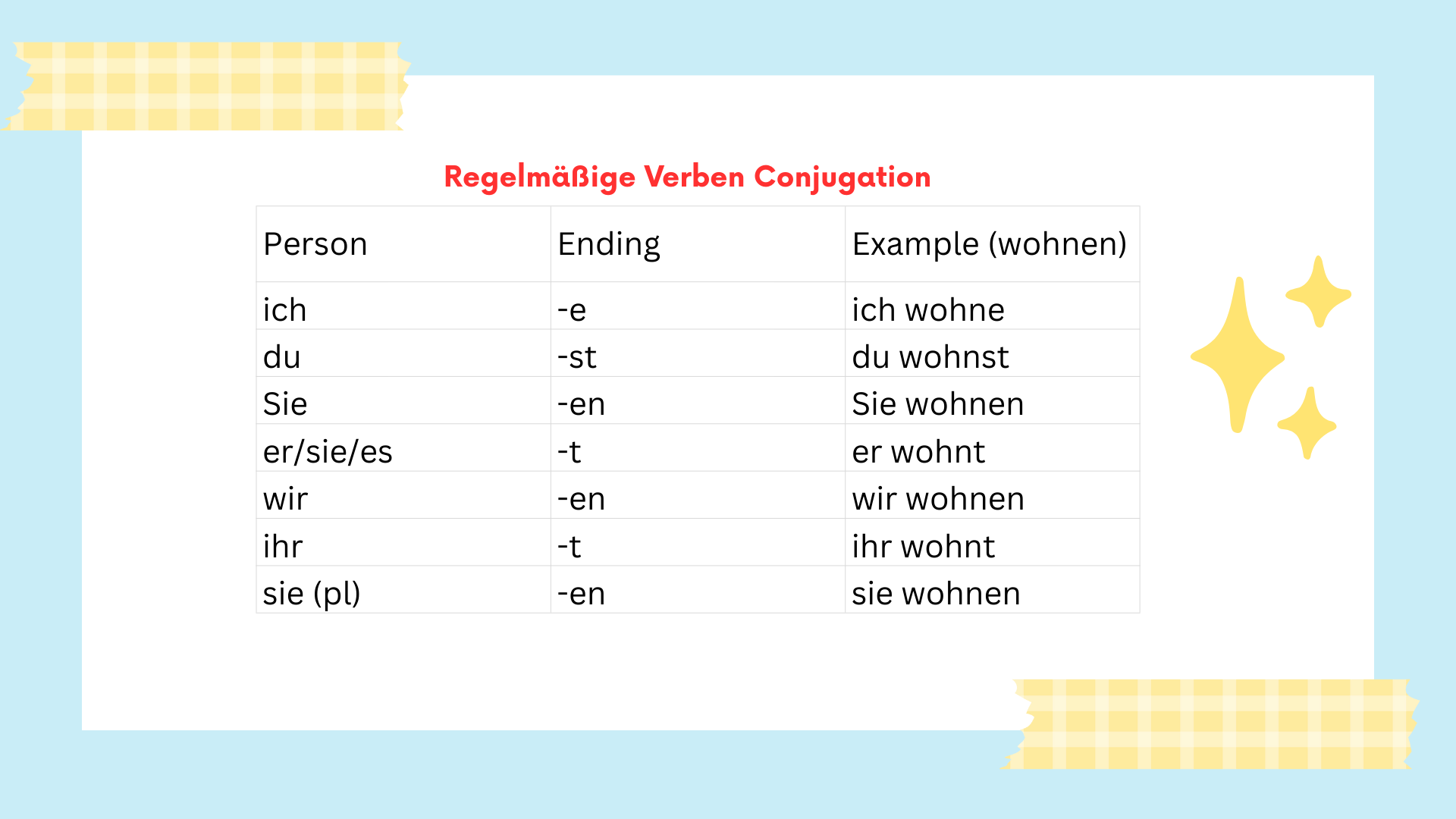
🔧 Verb Conjugation in Present Tense (Verbkonjugation im Präsens)
Regular verbs follow a predictable pattern:
Verb stem (Stamm) + personal ending (Endung)
📋 Conjugation Pattern:
| Person | Ending | Example (wohnen) |
|---|---|---|
| ich | -e | ich wohne |
| du | -st | du wohnst |
| Sie | -en | Sie wohnen |
| er/sie/es | -t | er wohnt |
| wir | -en | wir wohnen |
| ihr | -t | ihr wohnt |
| sie (pl) | -en | sie wohnen |
🔄 Examples of Regular Verbs
Let’s conjugate some common regular verbs:
1. Machen (to do, to make)
- ich mache
- du machst
- er/sie/es macht
- wir machen
- ihr macht
- Sie/sie machen
2. Spielen (to play)
- ich spiele
- du spielst
- er/sie/es spielt
- wir spielen
- ihr spielt
- Sie/sie spielen
3. Studieren (to study)
(Note: ends in -ieren, conjugated without -e in stem)
- ich studiere
- du studierst
- er/sie/es studiert
- wir studieren
- ihr studiert
- Sie/sie studieren
4. Lernen (to learn)
- ich lerne
- du lernst
- er/sie/es lernt
- wir lernen
- ihr lernt
- Sie/sie lernen
🎧 Special Pronunciation Rules
✅ Verbs ending in -s, -ß, or -z
In the du form, use -t instead of -st
Reisen (to travel)
- du reist (not reisst)
Tanzen (to dance)
- du tanzt (not tanzst)
✅ Verbs ending in -d or -t
Add an extra -e- before endings that begin with t or st
Arbeiten (to work)
- du arbeitest
- er arbeitet
Warten (to wait)
- du wartest
- er wartet
Antworten (to answer)
- du antwortest
- er antwortet
🧠 Recap
Today we learned how to:
- Conjugate regular verbs in the present tense
- Handle spelling adjustments with verb stems ending in -s, -ß, -z, -d, or -t
✨ With regular practice, these patterns become second nature!









Leave a Reply