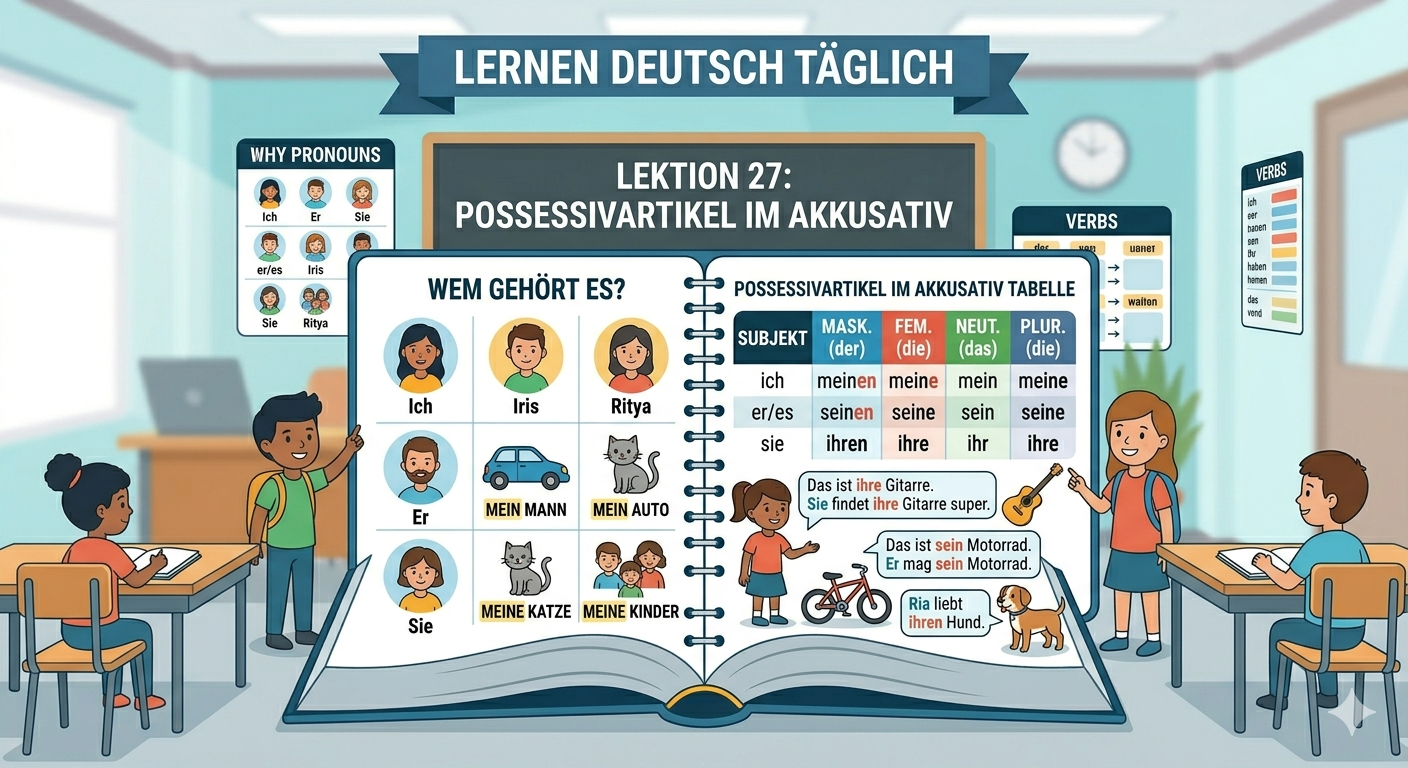
27. German language A1 : Possessive Articles in the Accusative Case (Possessivartikel im Akkusativ)
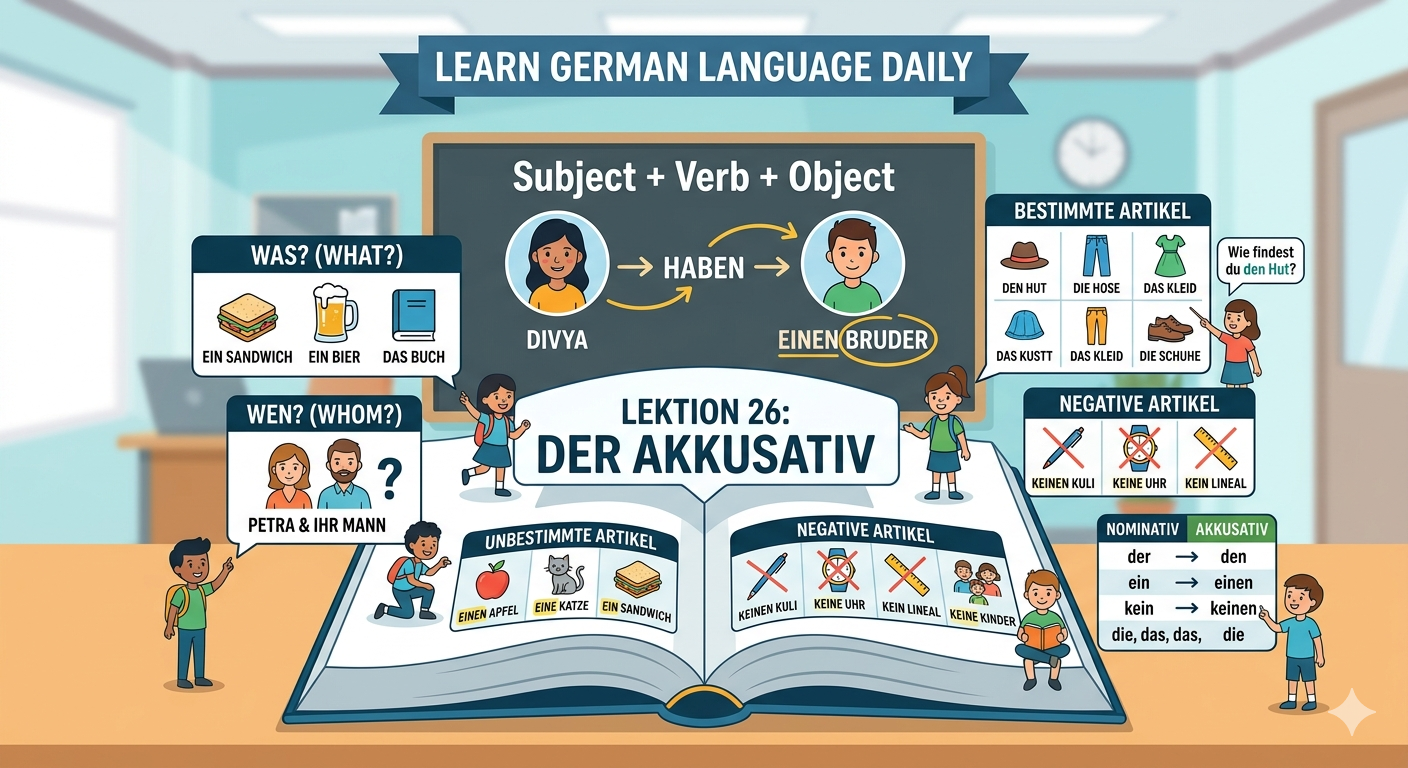
Welcome back to Learn German Language Daily! In our last lesson, we mastered the Accusative case (Akkusativ) with definite, indefinite, and negative articles. You learned the golden rule: Only the masculine gender changes!
Today, we are taking the next step in your German learning journey: Possessive Articles in the Accusative Case.
Whether you want to say “I love my dog,” “She likes her boyfriend,” or “Do you like your house?”, this guide will show you exactly how to do it correctly.
Quick Recall: What are Possessive Articles?
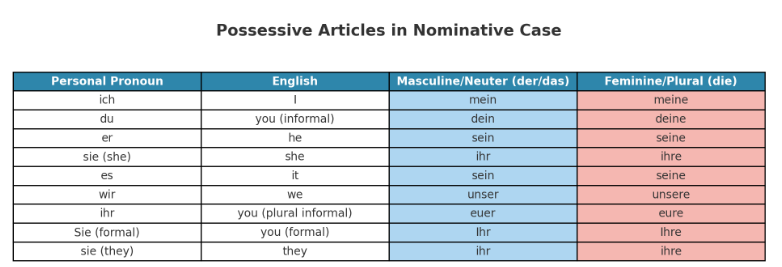
Possessive articles show ownership or belonging (like my, your, his, her, our, their in English). In the baseline Nominative case (the subject of the sentence), they look like this depending on the pronoun:
- ich (I) -> mein (my)
- du (you, informal) -> dein (your)
- er / es (he / it) -> sein (his / its)
- sie (she) -> ihr (her)
- wir (we) -> unser (our)
- ihr (you all) -> euer (your plural)
- sie / Sie (they / you formal) -> ihr / Ihr (their / your formal)
The Rule for Possessive Articles in the Accusative
Just like indefinite articles (ein changes to einen), possessive articles take the exact same endings in the Accusative case!
Because the Accusative case marks the direct object (the person or thing receiving the action), you only need to change the ending if the object is Masculine (der). Feminine (die), Neutral (das), and Plural (die) endings stay completely identical to the Nominative.
- Masculine (der) ->Adds -en (e.g., mein -> meinen)
- Feminine (die) -> Adds -e (e.g., mein -> meine)
- Neutral (das)-> No ending (e.g., mein)
- Plural (die) ->Adds -e (e.g., mein-> meine)
Step-by-Step Examples.
Let’s look at how native speakers change their possessive articles based on who is talking and what gender the object is.
1. Talking about yourself: “Ich” (My -> mein)
Meet Lili. She is introducing her life to us. Look at how her article changes only when she talks about her husband (masculine):
- Masculine (der Mann): Das ist mein Mann. -> Ich liebe meinen Mann. (This is my husband. I love my husband.)
- Why? “Ich” is the subject (Nominative), but “Mann” is the direct object being loved (Accusative).
- Neutral (das Auto): Das ist mein Auto.-> Ich liebe mein Auto. (This is my car. I love my car.)
- Feminine (die Katze): Das ist meine Katze. -> Ich liebe meine Katze. (This is my cat. I love my cat.)
- Plural (die Kinder): Das sind meine Kinder. -> Ich liebe meine Kinder. (These are my children. I love my children.)
2. Talking about a male: “Er” (His $\rightarrow$ sein-)
This is Iris. Let’s look at what he likes using his possessive pronoun sein:
- Masculine (der Hund): Das ist sein Hund. -> Er mag seinen Hund. (This is his dog. He likes his dog.)
- Neutral (das Motorrad): Das ist sein Motorrad. -> Er mag sein Motorrad. (This is his bike. He likes his bike.)
- Feminine (die Freundin): Das ist seine Freundin. -> Er mag seine Freundin. (This is his girlfriend. He likes his girlfriend.)
- Plural (die Freunde): Das sind seine Freunde. ->Er mag seine Freunde. (These are his friends. He likes his friends.)
3. Talking about a female: “Sie” (Her $\rightarrow$ ihr-)
This is Ritya. Let’s see what she thinks about her surroundings using ihr:
- Masculine (der Freund): Das ist ihr Freund. -> Sie findet ihren Freund nett. (This is her boyfriend. She finds her boyfriend nice.)
- Neutral (das Haus): Das ist ihr Haus. -> Sie findet ihr Haus schön. (This is her house. She finds her house beautiful.)
- Feminine (die Gitarre): Das ist ihre Gitarre. -> Sie findet ihre Gitarre super. (This is her guitar. She finds her guitar great.)
- Plural (die Nachbarn): Das sind ihre Nachbarn. -> Sie findet ihre Nachbarn freundlich. (These are her neighbors. She finds her neighbors friendly.)
Master Cheatsheet: Possessive Articles at a Glance (Akkusativ)
Use this complete table to quickly look up endings whenever you are forming a sentence with an Accusative object:
| Subject Pronoun | Masculine (der→ -en) | Feminine (die→ -e) | Neutral (das→ ø) | Plural (die→ -e) |
| ich (my) | meinen | meine | mein | meine |
| du (your) | deinen | deine | dein | deine |
| er / es (his/its) | seinen | seine | sein | seine |
| sie (her) | ihren | ihre | ihr | ihre |
| wir (our) | unseren | unsere | unser | unsere |
| ihr (your pl.) | euren | eure | euer | eure |
| Sie (your formal) | Ihren | Ihre | Ihr | Ihre |
| sie (their) | ihren | ihre | ihr | ihre |
⚠️ Grammar Note for “euer” (your plural): Notice that when adding an ending to euer, the middle “-e-” drops out! So it becomes euren / eure, NOT eueren / euere.
Put it into Practice: The Dog Owner Challenge!
Let’s see how the possessive article shifts naturally across different people when they talk about a masculine object (der Hund / the dog):
- Ich: Ich bin Ria und ich liebe meinen Hund. (I am Ria and I love my dog.)
- Du: Bist du Marim? Liebst du deinen Hund? (Are you Marim? Do you love your dog?)
- Sie (singular): Das ist Fria. Sie liebt ihren Hund. (This is Fria. She loves her dog.)
- Er: Das ist Karter. Er liebt seinen Hund. (This is Karter. He loves his dog.)
- Wir: Wir sind die Pixels. Wir lieben unseren Hund. (We are the Pixels. We love our dog.)
- Ihr: Seid ihr Nahir und Veda? Liebt ihr euren Hund? (Are you Nahir and Veda? Do you love your dog?)
- sie (plural): Das sind Feni und Jex. Sie lieben ihren Hund. (These are Feni and Jex. They love their dog.)
- Sie (formal): Sind Sie Herr und Frau Schumacher? Lieben Sie Ihren Hund? (Are you Mr. and Mrs. Schumacher? Do you love your dog?)
Und du? (And you?)
Now it is your turn to practice! Answer these four questions in the comments section below to practice your new grammar skills:
- Magst du deinen Freund / deine Freundin? (Do you like your boyfriend / your girlfriend?)
- Wie findest du dein Haus? (How do you find / What do you think of your house?)
- Liebst du deine Familie? (Do you love your family?)
- Hast du ein Haustier (pet)? Liebst du deinen Hund / deine Katze?
Check back tomorrow for Lesson 28 on Learn German Language Daily! Bis bald!









Leave a Reply