26. German language A1 : Mastering the Accusative Case (Akkusativ) in German
Welcome back to Learn German Language Daily! If you’ve been following our A1 series, you already know how to identify the subject of a sentence using the Nominative case.
Today, we are diving into one of the most important milestones in German grammar: The Accusative Case (Akkusativ). Don’t worry—while it might sound intimidating, it is actually quite straightforward once you spot the pattern.
Let’s break it down step-by-step!
What is the “Akkusativ”?
In English, we call this the direct object. The Accusative case is the person, animal, or thing that is directly receiving the action of the verb.
To find the Accusative object in a sentence, you simply need to ask two magic questions:
- Wen? (Whom?) — used for people
- Was? (What?) — used for things
Examples:
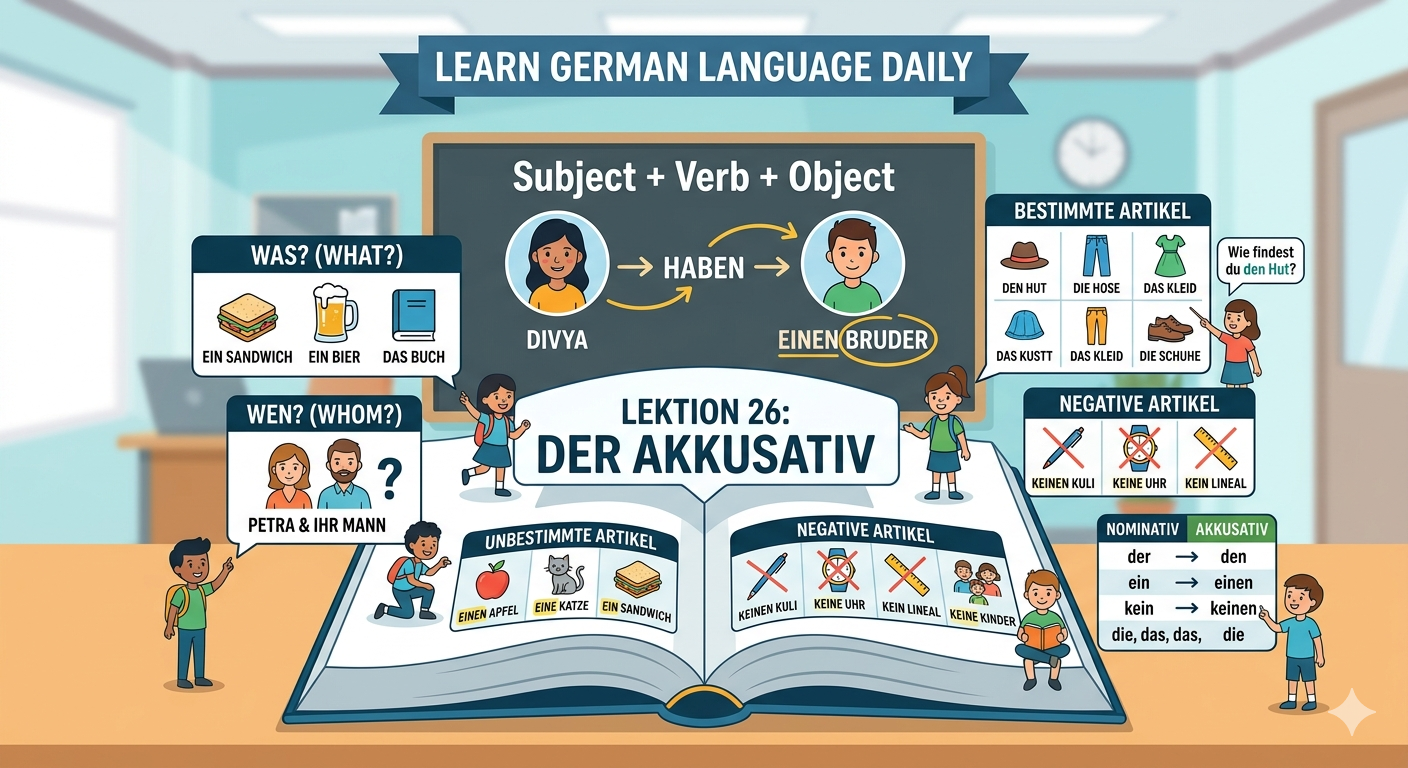
Sentence: Divya hat einen Bruder. (Divya has a brother.)
- Subject (Nominativ): Who has a brother? Divya.
- Object (Akkusativ): What/Whom does Divya have? einen Bruder.
Sentence: Wir haben ein Kind. (We have a child.)
- Subject (Nominativ): Wir (We).
- Object (Akkusativ): ein Kind (a child).
The Golden Rule of Akkusativ
Before we look at the tables, here is a massive secret that will make your life easier: Only the masculine gender (der) changes in the Accusative case! Feminine (die), Neutral (das), and Plural (die) stay exactly the same as they are in the Nominative.
Let’s look at how this applies to different types of articles.
1. Indefinite Articles (Unbestimmte Artikel)
We use indefinite articles when we are talking about “a” or “an” item in general. Notice how only the masculine ein changes to einen.
Summary Table: Indefinite Articles
| Case | Masculine | Feminine | Neutral | Plural |
| NOMINATIV | ein | eine | ein | – |
| AKKUSATIV | einen | eine | ein | – |
(Note: Just like in English, there is no plural for “a/an”. You cannot say “a brothers”.)
Sentence Examples:
- Masculine ($der$): Ich habe einen Bruder. (I have a brother.) / Er trinkt einen Saft. (He drinks a juice.)
- Feminine ($die$): Ich esse eine Pizza. (I am eating a pizza.) / Wir kaufen eine Lampe. (We are buying a lamp.)
- Neutral ($das$): Ich esse ein Sandwich. (I am eating a sandwich.) / Wir haben ein Baby. (We have a baby.)
- Plural: Ich habe zwei Brüder. (I have two brothers — no article needed).
2. Definite Articles (Bestimmte Artikel)
We use definite articles when talking about a specific item (“the”). Again, watch how der transforms into den, while everything else stays the same.
Summary Table: Definite Articles
| Case | Masculine | Feminine | Neutral | Plural |
| NOMINATIV | der | die | das | die |
| AKKUSATIV | den | die | das | die |
Real-Life Conversations:
How do you use this when talking about clothes or shopping?
- Masculine ( der Hut):
- A: Wie findest du den Hut? (How do you like the hat?)
- B: Den Hut finde ich schön. (I find the hat beautiful.)
- Feminine ( die Hose):
- A: Wie findest du die Hose? (How do you like the pants?)
- B: Die Hose finde ich cool. (I find the pants cool.)
- Neutral ( das Kleid):
- A: Wie findest du das Kleid? (How do you like the dress?)
- B: Das Kleid finde ich elegant. (I find the dress elegant.)
- Plural (die Schuhe):
- A: Wie findest du die Schuhe? (How do you like the shoes?)
- B: Die Schuhe finde ich teuer. (I find the shoes expensive.)
3. Negative Articles (Negative Artikel)
In German, to say you have “no” or “not any” of an object, you use kein. The endings perfectly match the indefinite articles, meaning masculine gets an -en ending (keinen).
Summary Table: Negative Articles
| Case | Masculine | Feminine | Neutral | Plural |
| NOMINATIV | kein | keine | kein | keine |
| AKKUSATIV | keinen | keine | kein | keine |
Q&A Examples:
- Masculine: Hast du einen Kuli? -> Nein, ich habe keinen Kuli. (No, I don’t have a pen.)
- Feminine: Hast du eine Uhr? -> Nein, ich habe keine Uhr. (No, I don’t have a watch.)
- Neutral: Hast du ein Lineal? -> Nein, ich habe kein Lineal. (No, I don’t have a ruler.)
- Plural: Hast du Kinder? -> Nein, ich habe keine Kinder. (No, I don’t have children.)
Let’s Compare: Nominativ vs. Akkusativ
To tie it all together, let’s see a single noun (der Apfel / the apple) move through different roles in a sentence. Look at how the article adapts based on its function:
- Das ist ein Apfel.
- Case: Nominativ
- Why: It follows the verb sein (to be), which acts like an equal sign (=), keeping the noun in the subject case.
- Der Apfel ist grün.
- Case: Nominativ
- Why: The apple is the subject performing the action of “being green”.
- Ich habe einen Apfel.
- Case: Akkusativ
- Why: “Ich” am the subject. What do I have? Einen Apfel (Direct object).
Master Cheatsheet: All Accusative Articles at a Glance
Save or screenshot this master table for your daily practice!
| Article Type | Masculine | Feminine | Neutral | Plural |
| Definite (The) | den | die | das | die |
| Indefinite (A/An) | einen | eine | ein | – |
| Negative (No/None) | keinen | keine | kein | keine |
Quick Tips for Practice:
Next time you practice your German, look closely at verbs like haben (to have), essen (to eat), trinken (to drink), and kaufen (to buy). These verbs almost always require an Accusative object!
What about you? Try writing your own sentence in the comments below using an Accusative article! Bis zum nächsten Mal! (Until next time!)










Leave a Reply