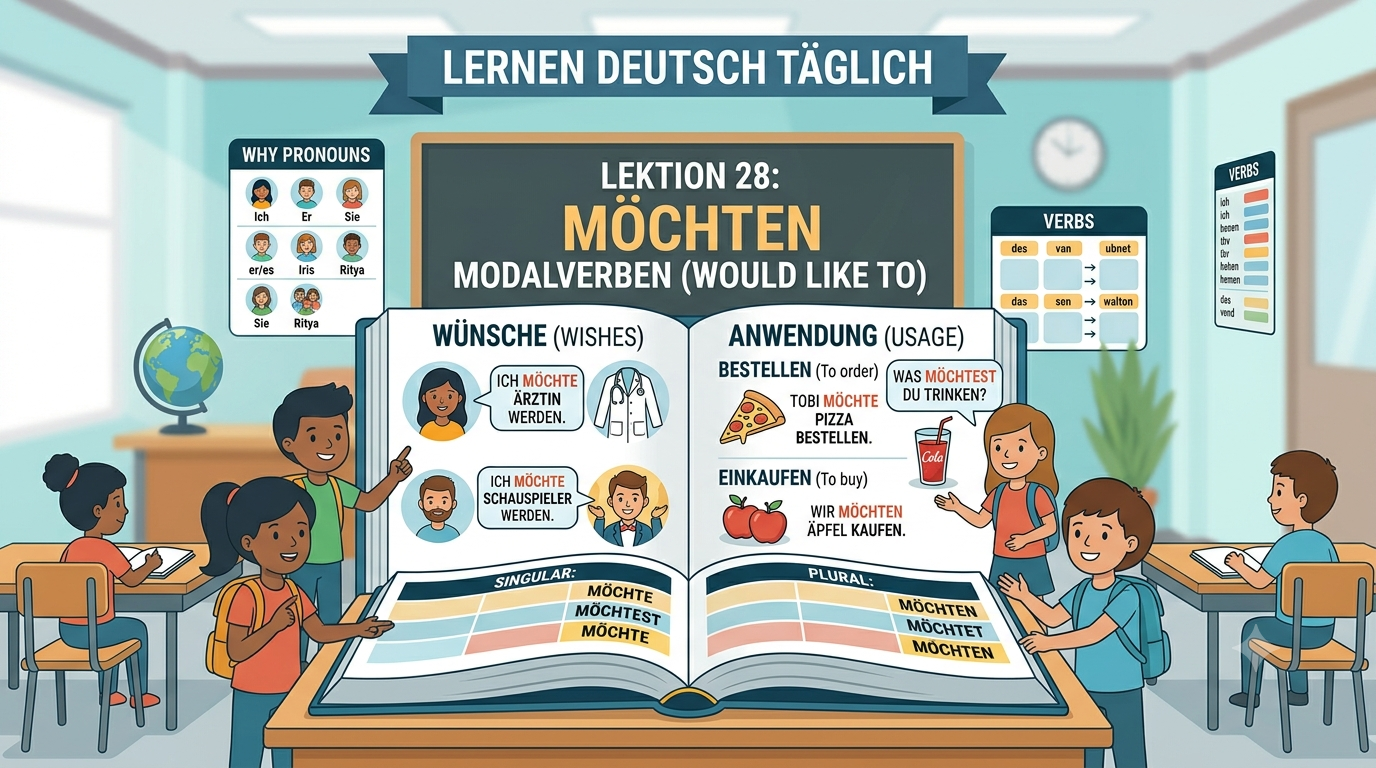
28. German language A1 : The Modal Verb “möchten” (Would Like To).
Welcome back to Learn German Language Daily! In our previous lessons, we mastered the Accusative case and learned how to talk about our possessions. Today, we are exploring a verb that will instantly make you sound incredibly polite and help you express your wishes: möchten (would like / would like to).
Whether you want to order food at a restaurant, buy something at a market, or talk about your future dreams, möchten is your go-to verb. Let’s break down how to use it, how to conjugate it, and where to place it in a sentence!
What is “möchten” and When Do We Use It?
In German, möchten is treated like a modal verb. We use it to express polite requests, desires, or intentions.
The 3 Main Usages (Anwendung):
- Ein Wunsch (A Wish / Dream): To talk about what you want to become or do in the future.
- Ich möchte Schauspieler werden. (I would like to be an actor.)
- Etwas bestellen (To order something): Perfect for cafes and restaurants.
- Ich möchte eine Pizza bestellen. (I would like to order a pizza.)
- Etwas einkaufen (To buy something): Ideal for shopping.
- Ich möchte Äpfel kaufen. (I would like to buy apples.)
💡 Short Cut Tip: If the context is completely obvious (like ordering a drink), you can omit the second verb at the end of the sentence!
- Ich möchte eine Cola. (I would like a cola.)
How to Conjugate “möchten”
Modal verbs have a unique conjugation pattern. The golden rule for möchten is that the “ich” (1st person singular) and “er/sie/es” (3rd person singular) forms are exactly identical! They both end in -e.
Here is your complete conjugation table:
Singular
- ich $\rightarrow$ möchte
- du $\rightarrow$ möchtest
- er / sie / es $\rightarrow$ möchte
- Sie (formal singular) $\rightarrow$ möchten
Plural
- wir $\rightarrow$ möchten
- ihr $\rightarrow$ möchtet
- sie (they) $\rightarrow$ möchten
- Sie (formal plural) $\rightarrow$ möchten
Sentence Structure: Where Does the Verb Go?
When you use möchten with another action verb (like essen, trinken, studieren), the sentence structure follows a strict formula.
1. In Regular Statements (Position 2 Rule)
The conjugated form of möchten sits firmly in Position 2. The other action verb (the main verb) is pushed all the way to the very end of the sentence in its basic, unchanged infinitive form.
Formula: Subject + möchten (conjugated) + Object/Details + Main Verb (Infinitive at the end)
- Ich möchte Ärztin werden. (I would like to be a doctor.)
- Peter möchte in England studieren. (Peter would like to study in England.)
- Tobi möchte eine Pizza bestellen. (Tobi wants to order a pizza.)
2. In Questions (W-Fragen and Ja/Nein-Fragen)
- W-Fragen (Open questions starting with W): The question word comes first, möchten takes Position 2, and the infinitive stays at the end.
- Was möchtest du essen? (What would you like to eat?)
- Ja-Nein-Fragen (Yes/No questions):Möchten moves to Position 1 to kick off the question, and the infinitive remains firmly pinned to the end.
- Möchtest du ins Kino gehen? (Would you like to go to the cinema?)
Mini-Exercise: Build Your Own Sentences!
Now it’s your turn to practice. Try unscrambling these words using the correct sentence structure rules we just learned, and post your answers in the comments below!
- trinken / ein Bier / ich / möchte
- nach Deutschland / möchtet / reisen / ihr / ?
- ein Auto / kaufen / wir / möchten
What about you? Write a sentence in the comments starting with “Ich möchte…” and tell us what you would like to do or buy today!
Coming soon Lesson 29 –>>
















Leave a Reply