
Top 100 German Verbs: A Comprehensive Guide to Mastering the Language
learning german can be both exciting and challenging. One of the most effective ways to build your language skills is by mastering the most commonly used verbs. Verbs are the backbone of any language, and by focusing on the top 100 German verbs, you can significantly improve your conversational abilities and comprehension. This blog will explore these essential verbs, their meanings, and examples of how they are used in sentences.
1. Sein (To be)
— Ich bin müde. (I am tired.)
2. Haben (To have)
— Sie hat ein Buch. (She has a book.)
3. Werden (To become, will)
— Er wird Arzt. (He becomes a doctor.)
— Es wird regnen. (It will rain.)
4. Können (Can, to be able to)
— Ich kann Deutsch sprechen. (I can speak German.)
5. Müssen (Must, have to)
— Du musst lernen. (You must study.)
6. Sollen (Should, supposed to)
— Ich soll pünktlich sein. (I should be on time.)
7. Wollen (To want)
— Wir wollen ein Haus kaufen. (We want to buy a house.)
8. Mögen (To like)
— Ich mag Pizza. (I like pizza.)
9. Dürfen (May, to be allowed to)
— Darf ich gehen? (May I leave?)
10. Machen (To make, to do)
— Er macht seine Hausaufgaben. (He does his homework.)
Verbs Related to Daily Activities
11. Kommen (To come)
— Er kommt nach Hause. (He comes home.)
12. Gehen (To go)
— Wir gehen ins Kino. (We are going to the cinema.)
13. Essen (To eat)
— Ich esse Frühstück. (I eat breakfast.)
14. Trinken (To drink)
— Sie trinkt Kaffee. (She drinks coffee.)
15. Schlafen (To sleep)
— Er schläft tief. (He sleeps deeply.)
16. Fahren (To drive, to go by vehicle)
— Ich fahre nach Berlin. (I am driving to Berlin.)
17. Arbeiten (To work)
— Sie arbeitet im Büro. (She works in the office.)
18. Lesen (To read)
— Er liest ein Buch. (He is reading a book.)
19. Schreiben (To write)
— Ich schreibe einen Brief. (I am writing a letter.)
20. Sprechen (To speak)
— Sie spricht Deutsch. (She speaks German.)
Essential Verbs for Communication
21. Sagen (To say)
— Was sagst du? (What are you saying?)
22. Fragen (To ask)
— Er fragt nach dem Weg. (He asks for directions.)
23. Antworten (To answer)
— Sie antwortet auf die Frage. (She answers the question.)
24. Erklären (To explain)
— Er erklärt den Plan. (He explains the plan.)
25. Hören (To hear)
— Ich höre Musik. (I am listening to music.)
26. Sehen (To see)
— Sie sieht den Sonnenuntergang. (She sees the sunset.)
27. Schauen (To look)
— Schau mal! (Look!)
28. Zeigen (To show)
— Er zeigt das Bild. (He shows the picture.)
29. Finden (To find)
— Ich finde meinen Schlüssel nicht. (I can’t find my key.)
30. Geben (To give)
— Er gibt ihr ein Geschenk. (He gives her a gift.)
Verbs for Emotions and States
31. Lieben (To love)
— Ich liebe dich. (I love you.)
32. Hassen (To hate)
— Er hasst Spinnen. (He hates spiders.)
33. Fühlen (To feel)
— Ich fühle mich glücklich. (I feel happy.)
34. Denken (To think)
— Sie denkt oft an die Zukunft. (She often thinks about the future.)
35. Glauben (To believe)
— Ich glaube an dich. (I believe in you.)
36. Wissen (To know)
— Ich weiß die Antwort. (I know the answer.)
37. Verstehen (To understand)
— Verstehst du das? (Do you understand that?)
38. Erinnern (To remember)
— Er erinnert sich an die Ferien. (He remembers the holidays.)
39. Vergessen (To forget)
— Ich habe den Termin vergessen. (I forgot the appointment.)
40. Wünschen (To wish)
— Ich wünsche dir alles Gute. (I wish you all the best.)
Verbs for Movement
41. Laufen (To run, to walk)
— Er läuft im Park. (He runs in the park.)
42. Springen (To jump)
— Sie springt vor Freude. (She jumps for joy.)
43. Fliegen (To fly)
— Wir fliegen nach Paris. (We are flying to Paris.)
44. Reisen (To travel)
— Ich reise gerne. (I like to travel.)
45. Schwimmen (To swim)
— Er schwimmt im Meer. (He swims in the sea.)
46. Bleiben (To stay, to remain)
— Ich bleibe zu Hause. (I am staying home.)
47. Verlassen (To leave)
— Er verlässt das Haus. (He leaves the house.)
48. Ankommen (To arrive)
— Der Zug kommt an. (The train arrives.)
49. Zurückkommen (To return)
— Ich komme bald zurück. (I will return soon.)
50. Eintreten (To enter)
— Treten Sie ein! (Come in!)
Verbs for Possession and Exchange
51. Besitzen (To own)
— Er besitzt ein Auto. (He owns a car.)
52. Bekommen (To get, to receive)
— Ich bekomme eine Nachricht. (I receive a message.)
53. Kaufen (To buy)
— Sie kauft ein Kleid. (She buys a dress.)
54. Verkaufen (To sell)
— Er verkauft sein Haus. (He is selling his house.)
55. Tauschen (To exchange)
— Wir tauschen Geschenke. (We exchange gifts.)
56. Leihen (To lend, to borrow)
— Ich leihe ihm ein Buch. (I lend him a book.)
57. Zahlen (To pay)
— Ich zahle die Rechnung. (I pay the bill.)
58. Kosten (To cost)
— Wie viel kostet das? (How much does it cost?)
59. Brauchen (To need)
— Ich brauche Hilfe. (I need help.)
60. Nehmen (To take)
— Er nimmt den Bus. (He takes the bus.)
Verbs for Learning and Education
61. Lernen (To learn)
— Ich lerne Deutsch. (I am learning German.)
62. Lehren (To teach)
— Er lehrt Geschichte. (He teaches history.)
63. Studieren (To study)
— Ich studiere an der Universität. (I study at the university.)
64. Üben (To practice)
— Sie übt Klavier. (She practices piano.)
65. Erforschen (To research)
— Er erforscht neue Technologien. (He researches new technologies.)
66. Entdecken (To discover)
— Sie entdeckt ein neues Talent. (She discovers a new talent.)
67. Vergleichen (To compare)
— Ich vergleiche die Preise. (I compare the prices.)
68. Erklären (To explain)
— Er erklärt die Regeln. (He explains the rules.)
69. Diskutieren (To discuss)
— Wir diskutieren das Problem. (We are discussing the
problem.)
70. Erkennen (To recognize)
— Ich erkenne ihn sofort. (I recognize him immediately.)
Verbs for Social Interactions
71. Treffen (To meet)
— Ich treffe meine Freunde. (I meet my friends.)
72. Besuchen (To visit)
— Er besucht seine Eltern. (He visits his parents.)
73. Feiern (To celebrate)
— Wir feiern Geburtstag. (We are celebrating a birthday.)
74. Einladen (To invite)
— Er lädt mich ein. (He invites me.)
75. Tanzen (To dance)
— Sie tanzt gerne. (She likes to dance.)
76. Sich unterhalten (To have a conversation)
— Wir unterhalten uns über das Wetter. (We are talking about the weather.)
77. Lachen (To laugh)
— Er lacht laut. (He laughs loudly.)
78. Weinen (To cry)
— Sie weint vor Freude. (She cries for joy.)
79. Rufen (To call, to shout)
— Er ruft nach Hilfe. (He calls for help.)
80. Schreien (To scream)
— Das Kind schreit. (The child screams.)
Verbs for Problem-Solving and Decision-Making
81. Entscheiden (To decide)
— Ich entscheide mich für das rote Kleid. (I decide on the red dress.)
82. Planen (To plan)
— Wir planen eine Reise. (We are planning a trip.)
83. Lösen (To solve)
— Er löst das Rätsel. (He solves the puzzle.)
84. Hoffen (To hope)
— Ich hoffe auf gutes Wetter. (I hope for good weather.)
85. Versuchen (To try)
— Sie versucht es noch einmal. (She tries again.)
86. Vermeiden (To avoid)
— Er vermeidet Fehler. (He avoids mistakes.)
87. Erreichen (To reach, to achieve)
— Sie erreicht ihr Ziel. (She reaches her goal.)
88. Schaffen (To manage, to accomplish)
— Ich schaffe es. (I can do it.)
89. Erlauben (To allow)
— Er erlaubt mir zu gehen. (He allows me to leave.)
90. Verhindern (To prevent)
— Sie verhindern den Unfall. (They prevent the accident.)
Verbs for Technology and Modern Life
91. Benutzen (To use)
— Ich benutze das Internet täglich. (I use the internet daily.)
92. Hochladen (To upload)
— Er lädt ein Video hoch. (He uploads a video.)
93. Herunterladen (To download)
— Sie lädt Musik herunter. (She downloads music.)
94. Speichern (To save)
— Ich speichere das Dokument. (I save the document.)
95. Löschen (To delete)
— Er löscht die Datei. (He deletes the file.)
96. Telefonieren (To call on the phone)
— Ich telefoniere mit meiner Mutter. (I am talking to my mother on the phone.)
97. Mailen (To email)
— Er mailt mir die Informationen. (He emails me the information.)
98. Drucken (To print)
— Ich drucke das Dokument aus. (I print out the document.)
99. Installieren (To install)
— Sie installiert die Software. (She installs the software.)
100. Aktualisieren (To update)
— Er aktualisiert die App. (He updates the app.)
Conclusion
Mastering these 100 German verbs will give you a strong foundation in the language. Whether you’re navigating daily activities, expressing emotions, or engaging in social interactions, these verbs will help you communicate more effectively and confidently. Practice using them in sentences, and you’ll soon find yourself speaking German with greater fluency.

German Vocabulary for Everyday Life: 300+ Essential German Words and Phrases
Learning German vocabulary is much easier when you learn words that you actually use in…
How to Pass the Telc / Goethe B1 German Schreiben Exam: Tips, Formulas & Essential Vocabulary

Sommer in Deutschland: Sonne, Eis und Biergärten ☀️🍦🍺
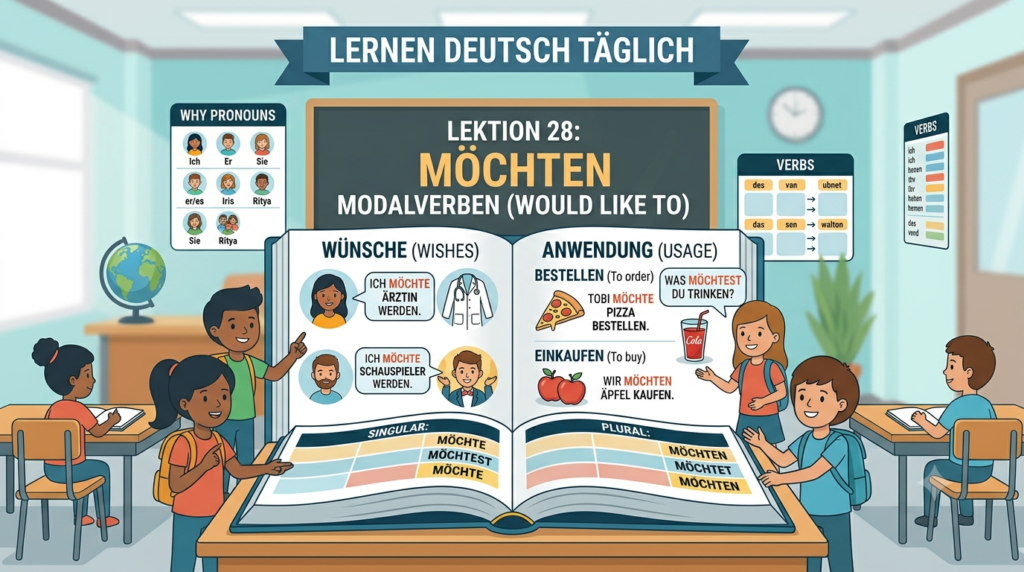
28. German language A1 : The Modal Verb “möchten” (Would Like To).
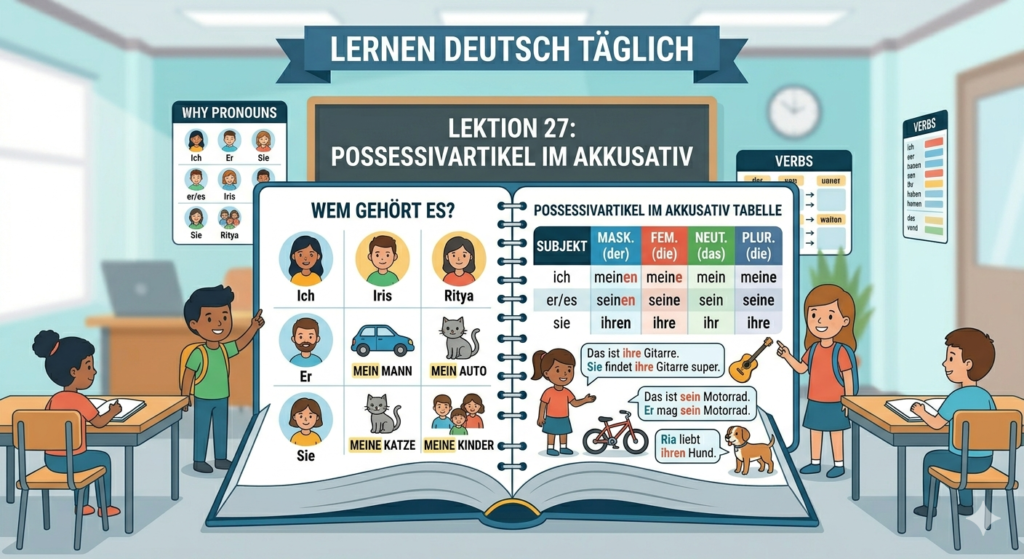
27. German language A1 : Possessive Articles in the Accusative Case (Possessivartikel im Akkusativ)

1 comment so far